 Dec, 23 2025
Getting the right dose of levothyroxine isn’t enough. If you’re taking it at the wrong time, or with the wrong things, your body might absorb less than half of what you’re paying for. That’s not a myth - it’s science. Studies show that up to 40% of people on levothyroxine have unstable TSH levels simply because of how and when they take their pill. And those fluctuations? They can mean fatigue, weight gain, brain fog, or worse - even if your dose looks perfect on paper.
Why Timing Matters More Than You Think
Levothyroxine is a synthetic version of the thyroid hormone T4. Your body needs it to keep your metabolism, heart rate, and brain function running smoothly. But here’s the catch: this pill doesn’t work well if it’s mixed with food, coffee, or supplements. It needs an empty stomach to be absorbed properly. Research from the Academic Endocrinology Society found that only 60% to 80% of a levothyroxine dose is absorbed when taken with food. That means if you take your pill with breakfast, you’re essentially underdosing yourself. And because levothyroxine has a long half-life - about 7 days - even small daily inconsistencies build up. One missed fasting window might not seem like much, but over weeks, your TSH levels start to drift. Your doctor checks TSH (thyroid-stimulating hormone) to see if your dose is right. The target range is 0.4 to 4.0 mIU/L. But if your absorption is inconsistent, your TSH might jump from 1.8 to 5.2 - not because your dose is wrong, but because your timing was off. That’s why so many patients end up getting their doses changed unnecessarily.The Gold Standard: Morning Fasting
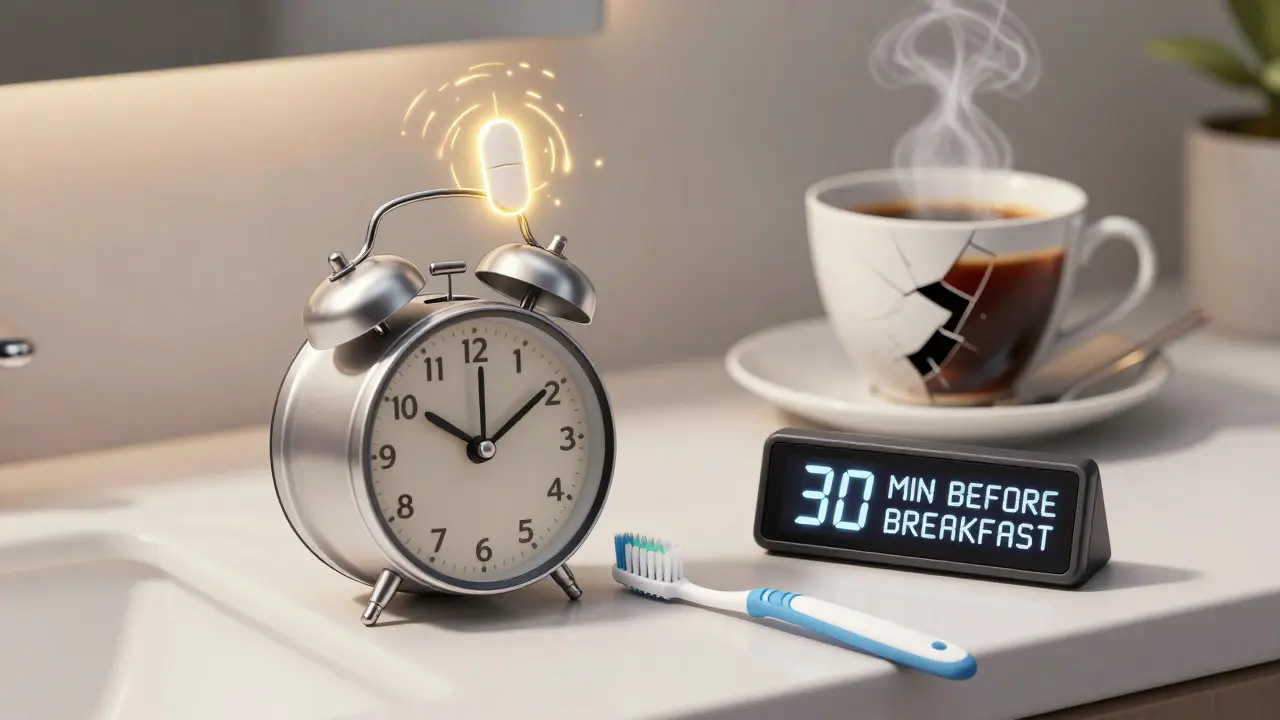
The most proven method is taking levothyroxine on an empty stomach, 30 to 60 minutes before breakfast. This is the recommendation from the American Thyroid Association in its 2021 guidelines, the FDA in the Synthroid labeling, and nearly every major endocrinology group. Why does this work? Levothyroxine is absorbed best in an acidic environment in the upper small intestine. Food, especially anything with calcium, iron, or fiber, neutralizes stomach acid and blocks absorption. Even a small bowl of oatmeal or a banana can reduce absorption by 15-20%. A 2019 study in Thyroid journal tracked 45 patients who switched between taking levothyroxine with breakfast and before breakfast. When taken with food, their average TSH rose from 1.7 to 2.9 - a significant shift. When taken before breakfast, TSH stayed steady at 1.9. That’s the difference between feeling fine and feeling exhausted.What You Must Avoid Within 4 Hours
It’s not just food. Many common items interfere with levothyroxine absorption. Here’s what you need to keep away for at least 4 hours after taking your pill:- Calcium supplements - Reduce absorption by 27-36%
- Iron supplements - Drop absorption by up to 59%
- Coffee - Even one cup lowers absorption by 9-14%
- Soy products - Tofu, soy milk, edamame - cut absorption by 20-30%
- High-fiber meals - Bran cereal, whole grains, legumes - reduce uptake by 15-25%
- Proton pump inhibitors (PPIs) - Drugs like omeprazole lower stomach acid and reduce absorption by 15-22%

Bedtime Dosing: A Viable Alternative?
You’re not alone if you can’t wait 60 minutes before breakfast. Maybe you’re a shift worker. Maybe you’re rushed. Maybe you get stomach cramps - what some call ‘levo belly’ - when taking it on an empty stomach. Here’s the good news: bedtime dosing is now officially recognized as an option. The American Thyroid Association updated its 2023 guidelines to say bedtime dosing 'may be considered' for patients who can’t fast before breakfast. The science is mixed, but leaning positive. A 2022 study of 150 patients found no difference in TSH control between morning and evening dosing - as long as both were taken on an empty stomach. The key is consistency. If you take it at 10 p.m., don’t switch to 8 p.m. the next night. Why bedtime works: your stomach is naturally empty after dinner. No coffee, no soy, no calcium. Plus, you’re not rushing. A 2022 survey found 79% of patients stuck with bedtime dosing because it was easier to remember than the morning routine. But there’s a catch: if you eat a late snack or drink alcohol before bed, you’re breaking the fast. And if you’re on other nighttime meds - like calcium or iron - you can’t take them within 4 hours of your levothyroxine. That’s why many people find it easier to take levothyroxine alone, first thing in the morning.What About New Formulations Like Tirosint?
If you’ve tried everything and still struggle with absorption, you might have heard of Tirosint - a liquid-filled softgel capsule. Unlike regular tablets, it’s not affected by food or coffee as much. Studies show it reduces absorption loss from 20-30% down to just 8-12% when taken with food. That sounds perfect, right? But here’s the reality: Tirosint costs 3 to 5 times more than generic levothyroxine. A month’s supply can run $50 vs. $10 for the generic. Most insurance plans won’t cover it unless you’ve tried and failed with standard tablets. It’s not a magic fix. You still need to avoid calcium and iron. But if you’re someone who can’t stick to the timing rules - maybe you travel often, or have a chaotic morning - Tirosint might be worth the cost. Talk to your doctor. It’s not for everyone, but for some, it’s life-changing.Real-Life Tips That Actually Work
Knowing the rules is one thing. Following them every day is another. Here’s what works for real people:- Place your pill next to your toothbrush. That’s what 78% of endocrinologists recommend. When you brush your teeth, you take your pill. Simple.
- Use a pill organizer with clear labels. Write ‘NO FOOD FOR 60 MIN’ on the compartment. Visual cues stick better than memory.
- Set two alarms. One for taking the pill. One for breakfast. That way, you don’t rush and forget the gap.
- Take it with a full glass of water. Not juice, not coffee, not milk. Water helps the pill dissolve properly and moves it through your system faster.
- Use a tracking app. Apps like MyThyroidMedication have been shown to improve adherence by 34%.

Special Cases: Thyroid Cancer and Pregnancy
If you’ve had thyroid cancer, your TSH target is much tighter - usually between 0.1 and 0.5 mIU/L. Even a 10% drop in absorption can push you out of range. For these patients, morning fasting isn’t optional. It’s mandatory. No exceptions. Pregnant women on levothyroxine also need strict timing. Thyroid hormone needs increase by 30-50% during pregnancy. If absorption is poor, it can affect fetal brain development. Always take your pill before breakfast. Don’t skip days. And tell your OB-GYN you’re on levothyroxine - they’ll likely check your TSH every 4-6 weeks.What If You Forget?
If you miss your morning dose, don’t panic. You can take it later in the day - as long as you wait 4 hours after eating and 4 hours before your next meal. If you remember at night, take it then - as long as it’s at least 3-4 hours after dinner. Never double up the next day. Levothyroxine stays in your system for days. Taking two pills at once won’t fix yesterday’s missed dose - it’ll just make you jittery or give you a fast heartbeat.Bottom Line: Consistency Beats Perfection
You don’t need to be perfect. You just need to be consistent. Whether you choose morning fasting or bedtime dosing, pick one and stick to it. Don’t switch back and forth. That’s what causes TSH swings. Most people think thyroid medication is simple. It’s not. It’s one of the most timing-sensitive drugs in medicine. But once you get the rhythm down - pill, water, wait, eat - everything else gets easier. Your energy comes back. Your brain clears. Your weight stabilizes. And that’s not just theory. That’s what happens when you treat your pill like the medicine it is - not a suggestion, but a non-negotiable part of your daily health routine.Can I take levothyroxine with coffee?
No. Coffee - even one cup - can reduce levothyroxine absorption by 9-14%. Wait at least 60 minutes after taking your pill before drinking coffee. Some people switch to tea or water in the morning to avoid the issue entirely.
Can I take levothyroxine at night instead of in the morning?
Yes, if you can’t stick to the morning routine. Taking levothyroxine at bedtime, at least 3-4 hours after your last meal, is now an accepted alternative. Studies show it works just as well as morning dosing - as long as you’re consistent and avoid food, supplements, or alcohol within 4 hours.
Why does my TSH keep changing even though I take my pill every day?
If you’re taking your pill with food, coffee, calcium, iron, or soy, your body isn’t absorbing the full dose. Even small timing changes - like taking it 20 minutes before breakfast one day and 10 minutes before another - can cause TSH to fluctuate. The fix isn’t a higher dose. It’s a better routine.
Is generic levothyroxine as good as brand names like Synthroid?
For most people, yes. But generic versions can vary slightly in fillers and absorption rates. If you switch brands and notice new symptoms - fatigue, heart palpitations, weight changes - tell your doctor. Some patients do better staying on the same brand. The FDA now requires stricter bioequivalence standards, but consistency in brand matters for sensitive patients.
How long does it take to see results after fixing my timing?
It takes about 4-6 weeks for your TSH levels to stabilize after changing your dosing routine. That’s because levothyroxine has a 7-day half-life - your body needs time to reach a new steady state. Don’t rush to get your blood drawn. Wait at least 4-6 weeks after making a change, then ask your doctor to check your TSH again.
Can I take levothyroxine with my other medications?
Only if they’re spaced out. Calcium, iron, antacids, and PPIs must be taken at least 4 hours after levothyroxine. Some patients take their vitamins at lunch and their levothyroxine at night to avoid conflicts. Always check with your pharmacist or doctor before combining medications.
Aurora Daisy
December 25, 2025 AT 08:56Oh wow, another article telling us we’re all doing it wrong. Thanks for the guilt trip, Doctor. I take my pill with coffee because I’m not a robot. My TSH is fine. If your numbers are junk, maybe your doctor sucks, not your coffee habit.
Paula Villete
December 26, 2025 AT 02:15Okay but… what if you’re a single mom who wakes up at 4am to pump breastmilk, then runs out the door with a baby on one hip and a thermos of coffee in the other? You don’t get 60 minutes. You get 12 seconds and a prayer. This advice is great… for people who have a morning that looks like a Pinterest board.
Katie Taylor
December 26, 2025 AT 16:08THIS. Finally someone says it. I switched to bedtime dosing after 3 years of brain fog and panic attacks. My TSH went from 4.8 to 1.5 in 8 weeks. No dose change. Just timing. My doctor was skeptical until my labs came back. Now she tells other patients about it. Consistency > perfection. Period.
Payson Mattes
December 26, 2025 AT 20:44Did you know the FDA quietly changed the absorption standards for levothyroxine in 2019 to favor big pharma? Tirosint is way more effective but they made it expensive so you keep buying the cheap stuff that doesn’t work right. And coffee? They say it reduces absorption, but they never mention that calcium in dairy is 3x worse. Why? Because milk companies fund the thyroid associations. Wake up.
Isaac Bonillo Alcaina
December 27, 2025 AT 06:14You’re all missing the point. If you’re relying on timing alone to fix your TSH, you’re ignoring the root cause: gut dysbiosis. Levothyroxine absorption is tied to intestinal permeability. If your microbiome is wrecked from antibiotics, sugar, or gluten, no amount of fasting will help. Get a stool test. Fix your gut. Then worry about coffee.
Bhargav Patel
December 28, 2025 AT 19:07It is indeed a matter of profound physiological precision. The pharmacokinetics of levothyroxine are exquisitely sensitive to gastric pH, intestinal transit time, and the presence of divalent cations. The human body, as a self-regulating system, demands rhythmicity. To disrupt the temporal integrity of administration is to invite homeostatic drift. One must approach this not as a chore, but as a ritual of bodily reverence.
Steven Mayer
December 29, 2025 AT 04:08Half-life of T4: 7 days. Bioavailability variance with food: 20-30%. TSH lag time to equilibrium: 4-6 weeks. Absorption inhibition by calcium: 36%. Iron: 59%. Coffee: 14%. PPIs: 22%. The data is robust. The protocol is non-negotiable. Deviation = suboptimal therapy. No emotion. Just metrics.
Charles Barry
December 30, 2025 AT 06:44Of course the guidelines say morning fasting. They always do. Because the people writing them have 9-to-5 jobs, no kids, and a chef who makes them avocado toast at 7am. Meanwhile, I work nights. I take it at 11pm after my shift. My TSH is stable. But hey, if you’re gonna judge people for not having a perfect life, go ahead. I’ll be over here, not dying.
Rosemary O'Shea
December 30, 2025 AT 17:48How quaint. You think this is about thyroid health? No. It’s about control. The medical-industrial complex needs you to believe you’re broken unless you follow their 17-step ritual. They profit from your anxiety, your endless blood tests, your $50 capsules. Wake up. You’re not a machine. You’re a human being with a life.
Bartholomew Henry Allen
December 31, 2025 AT 15:15Take pill on empty stomach before breakfast. Avoid calcium iron coffee soy fiber PPIs. Bedtime alternative if consistent. Tirosint expensive but works better for some. Track with app. Wait 4-6 weeks for results. No exceptions. Do it.
Jeffrey Frye
January 1, 2026 AT 01:55so i took mine with my oatmeal cause i was tired and then my tsh went nuts and i thought i needed more but then i read this and switched to before coffee and now i feel like a new person?? like i forgot what energy was?? idk man just wanted to say thanks??
claire davies
January 2, 2026 AT 10:27Oh honey, I’ve been there. I used to take mine with my matcha latte and wonder why I felt like a zombie in a grey sweater. Then I started keeping it by my toothbrush - same spot every day. Now I brush, swallow, wait, then make my coffee. It’s become my little sacred moment. I don’t feel like a patient anymore. I feel like someone who finally knows how to take care of herself. And you know what? That’s worth more than any pill.
Wilton Holliday
January 3, 2026 AT 20:06Just wanted to say - if you’re reading this and feeling overwhelmed, you’re not alone. This stuff is hard. But you’re doing better than you think. One consistent day at a time. You got this. 💪