 Jan, 6 2026
When you’re taking a proton pump inhibitor (PPI) for heartburn and suddenly need an antifungal for a stubborn yeast infection, things get complicated-fast. These two types of drugs don’t just sit quietly in your body. They bump into each other in ways that can make one or both less effective, sometimes dangerously so. The problem isn’t just about stomach acid. It’s about how your body absorbs drugs, how your liver processes them, and even how fungi respond to them in surprising ways.
Why PPIs Change How Antifungals Work
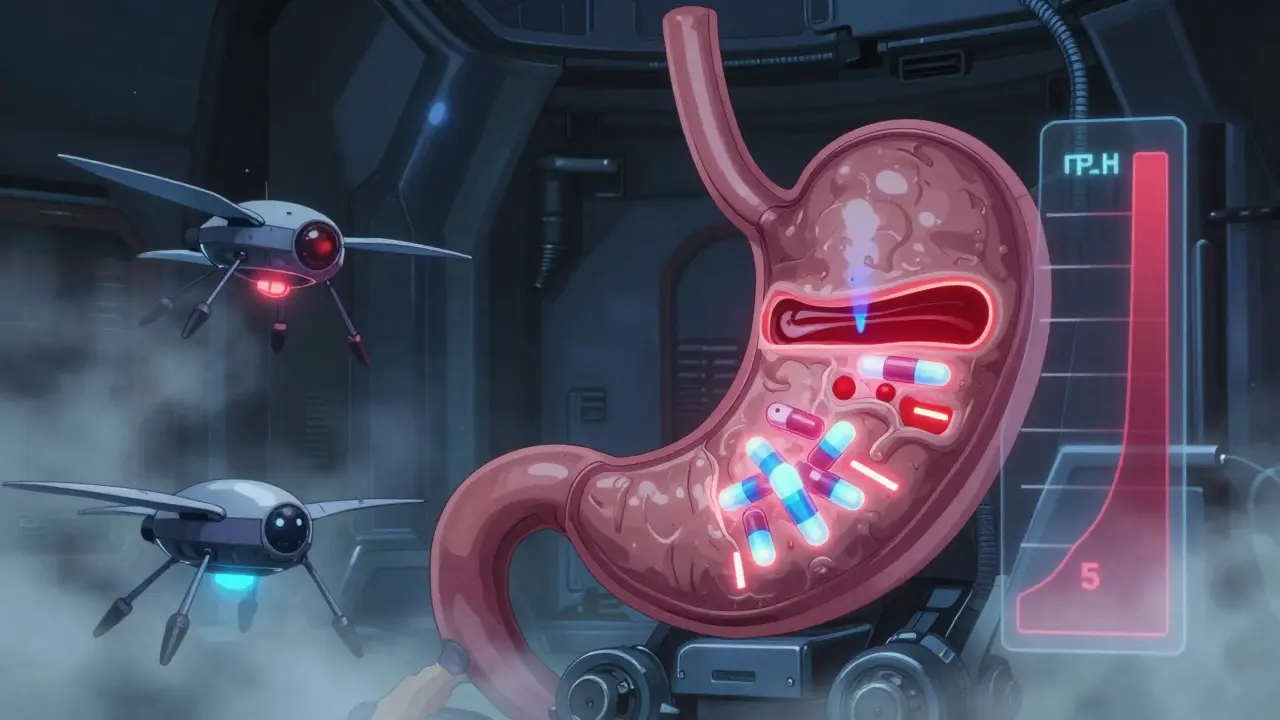
Proton pump inhibitors like omeprazole, pantoprazole, and esomeprazole work by shutting down the acid-producing pumps in your stomach. That’s great if you have GERD. But it’s a problem for certain antifungals that need acid to dissolve properly. Think of it like trying to dissolve a sugar cube in water versus soda. The sugar melts easily in soda because it’s acidic. In plain water? Not so much. Ketoconazole and itraconazole are two antifungals that absolutely need stomach acid to get absorbed. When you take a PPI, your stomach pH rises from about 1.5 to 5 or higher. That tiny change cuts the absorption of itraconazole by up to 60%, according to a 2023 study in JAMA Network Open that tracked over 1,200 patients. Ketoconazole isn’t much better-its solubility drops from 22 mg/mL at normal stomach acidity to just 0.02 mg/mL when acid is suppressed. That means your blood levels of the drug can fall below what’s needed to kill fungi.Fluconazole: The Exception That Proves the Rule
Not all antifungals play by the same rules. Fluconazole is water-soluble, which means it doesn’t need acid to dissolve. Its absorption stays steady at around 90% no matter how high your stomach pH climbs. That’s why fluconazole is often the go-to choice when someone’s on a PPI and needs systemic antifungal treatment. The FDA updated its prescribing info in January 2024 to confirm this stability across pH levels. But here’s the catch: fluconazole has its own problems. It doesn’t mess with absorption, but it does interfere with how your liver breaks down other drugs. At doses above 200 mg per day, it blocks CYP3A4, and even at 100 mg, it hits CYP2C9. That’s the enzyme that processes warfarin, a common blood thinner. If you’re on both fluconazole and warfarin, your INR can spike, increasing bleeding risk. A 2023 FDA database shows that warfarin doses often need to be cut by 20-30% when fluconazole is added.The Voriconazole Puzzle
Voriconazole sits in the middle. It doesn’t rely on stomach acid for absorption, so a PPI won’t stop it from entering your bloodstream. But here’s where it gets tricky: voriconazole is broken down by CYP2C19 and CYP3A4. And guess what? Pantoprazole and other PPIs block those same enzymes. A 2015 study in Antimicrobial Agents and Chemotherapy found that when PPIs are added, voriconazole clearance drops by 25-35%. That means the drug builds up in your system, raising the risk of side effects like vision changes, liver damage, or skin rashes. That’s why hospitals like the Cleveland Clinic now require voriconazole blood levels to be checked within 72 hours of starting a PPI. If levels are too high, they reduce the dose by 25-50%. It’s not just about making the drug work-it’s about keeping you safe.
The Unexpected Twist: PPIs Might Help Antifungals
Here’s where things get wild. A 2024 study in PMC10831725 found something no one expected: PPIs might actually boost the power of certain antifungals. In lab tests, omeprazole was shown to block a fungal enzyme called Pam1p, which is part of the yeast’s defense system. When that enzyme is turned off, even resistant strains of Candida glabrata become sensitive again. The study showed that when fluconazole was paired with omeprazole, the minimum dose needed to kill the fungus dropped by 4 to 8 times. This isn’t just lab magic. It’s a potential game-changer. Imagine using a common, cheap heartburn drug to make a failing antifungal work again. Dr. Mahmoud Ghannoum from Case Western Reserve University called it a "new therapeutic possibility" in a March 2024 webinar. Right now, Johns Hopkins is running a Phase II trial (NCT05876543) testing whether adding omeprazole to fluconazole can treat stubborn candidiasis. Results are expected by late 2025.What Doctors Actually Do in Real Life
In practice, most infectious disease specialists avoid the whole mess. A 2023 survey of 217 pharmacists showed that 87% prefer switching to an echinocandin-like caspofungin or micafungin-when a patient on a PPI needs antifungal therapy. Echinocandins don’t rely on stomach acid or liver enzymes. They’re given by IV and work directly on the fungal cell wall. They’re more expensive, sure, but they’re predictable. For itraconazole, the FDA added a black box warning in June 2023: "Concomitant administration with proton pump inhibitors is contraindicated." The European Medicines Agency followed suit. Yet, a 2024 audit by the Institute for Safe Medication Practices found that over 22% of itraconazole prescriptions in pharmacies were still being paired with PPIs. That’s not just a mistake-it’s a risk.
How to Handle This in Real Life
If you’re on a PPI and need an antifungal, here’s what actually works:- For itraconazole or ketoconazole: Avoid PPIs entirely. Switch to an echinocandin or consider the newer SUBA-itraconazole formulation, which bypasses stomach acid and works even with PPIs.
- For fluconazole: It’s generally safe, but watch for interactions with blood thinners, seizure meds, or statins. Your doctor may need to adjust those doses.
- For voriconazole: Get a blood level test within 3 days of starting a PPI. Adjust the dose based on results.
- If you absolutely must take both: Give itraconazole at least 2 hours before the PPI. This only cuts the absorption loss from 60% to 45%, according to Mayo Clinic guidelines-but it’s better than nothing.
Kamlesh Chauhan
January 7, 2026 AT 20:27So let me get this right some fancy pill for heartburn is messing with my yeast meds and no one told me this before now I feel like a lab rat
Jessie Ann Lambrecht
January 8, 2026 AT 06:56This is exactly why I always ask my pharmacist about drug interactions before filling anything. Most people don’t realize how many hidden conflicts are in their medicine cabinet. Fluconazole with warfarin? That’s a ticking time bomb. Always check the labels. Your life might depend on it.
Rachel Steward
January 9, 2026 AT 01:43The real tragedy here isn’t the drug interaction-it’s the systemic failure of medical education. We’re teaching doctors to prescribe like they’re playing Jenga, pulling out one block while ignoring the whole damn tower. PPIs aren’t harmless sugar pills. They’re biochemical wrecking balls, and we’ve normalized their overuse because they’re profitable and convenient. Meanwhile, patients are left to guess which of their meds is quietly poisoning them.
And don’t even get me started on the FDA’s slow-motion response. By the time they update a black box warning, half the population has already been screwed. This isn’t science. It’s corporate triage dressed in white coats.
The fact that a heartburn drug can reverse antifungal resistance? That’s not a quirk-it’s a revelation. But instead of exploring it as a therapeutic avenue, we’re still stuck in the ‘avoid at all costs’ mindset. We’re afraid of complexity, so we avoid innovation. That’s not medicine. That’s fear-driven inertia.
And yes, I’ve seen patients on voriconazole with undiagnosed PPI interactions. The vision distortions? The liver enzymes spiking? They were dismissed as ‘side effects’ when they were actually pharmacokinetic collisions. Someone needs to audit every hospital pharmacy in this country.
It’s not just about dosing. It’s about culture. We treat drugs like Lego bricks-snap them together and hope they don’t fall apart. But biology doesn’t care about convenience. It’s a symphony of enzymes, pH levels, and transporters. And we’re conducting it with a kazoo.
Suba-itraconazole? Brilliant. But why did it take a decade and a patent to fix something that should’ve been obvious in 2010? Because profit > patient. Always.
Next time your doctor prescribes a PPI for ‘just a little heartburn,’ ask them if they’ve ever had to treat a patient whose antifungal failed because of it. If they look away? Run.
Aparna karwande
January 10, 2026 AT 13:11How is it possible that in 2025, we still don’t have a centralized drug interaction database that’s mandatory for all prescribers? This isn’t rocket science-it’s basic pharmacology. Someone in a lab in India or Nigeria is probably already developing an AI that predicts these clashes before the drug even hits the market. Meanwhile, we’re still relying on doctors who memorized drug interactions from a 2007 pocket guide.
And let’s talk about the hypocrisy: we vilify traditional medicine for being unscientific, but we glorify Big Pharma’s ‘evidence-based’ approach while ignoring that 87% of pharmacists avoid PPI-azole combos because they know the data is garbage. If a pharmacist won’t fill it, why are we still writing it?
Also, omeprazole helping kill Candida? That’s not a side effect-that’s a revolution. We’ve been treating fungal infections like they’re bacterial. We need to stop thinking in antibiotics and start thinking in fungal ecology. The yeast isn’t the enemy. The environment is.
And who approved the 22% prescription error rate? Who’s getting fired for that? No one. Because the system isn’t broken-it’s working exactly as designed. Profit over patient. Always.
Next time you get a PPI, ask your doctor if they’ve ever had to watch someone bleed out because fluconazole spiked their INR. If they say no? Then they’ve never been on the front lines. And you’re not a patient. You’re a statistic.
Elen Pihlap
January 11, 2026 AT 00:58i just took omeprazole and fluconazole together and now my head is spinning and i feel like crying why is this happening
Ayodeji Williams
January 12, 2026 AT 02:21bro u just got scammed 😭 the system is rigged. PPIs are just corporate poison. i saw a video on tiktok that said they’re linked to dementia too. u better stop now before u turn into a zombie 🧟♂️💀
Paul Mason
January 13, 2026 AT 00:47Man, I had no idea about this. I’ve been on omeprazole for years and just popped fluconazole last month for a yeast thing. I’m lucky I didn’t end up in the ER. Thanks for the heads-up-this is the kind of stuff you don’t hear on TV.
steve rumsford
January 13, 2026 AT 02:24so basically ppi = bad for antifungals except when its good for antifungals wait what
Kyle King
January 14, 2026 AT 21:37Did you know the FDA and Big Pharma are hiding this on purpose? They don’t want you to know PPIs can help fight fungus because then people would stop buying expensive antifungals. This is all a scheme to keep you dependent on drugs that cost $300 a pill. The real cure? Fasting and lemon water. They don’t want you to know that.
Vince Nairn
January 15, 2026 AT 11:00so we have a drug that makes antifungals work better but we’re not using it because… profit? wow. the system is so broken it’s almost poetic
Sai Ganesh
January 17, 2026 AT 03:13As someone from India where fungal infections are common and PPIs are sold over the counter, this is critical information. Many patients here take both without knowing the risks. We need public health campaigns in local languages-not just academic papers. Knowledge should be accessible, not locked behind paywalls.
Also, the idea of repurposing omeprazole as an antifungal adjuvant is brilliant. It’s cheap, available, and already approved. Why aren’t we scaling this? Maybe because it doesn’t have a patent. That’s the saddest part.
Anthony Capunong
January 17, 2026 AT 11:07Look, I’m not some medical expert, but I’ve seen too many people get hurt because doctors treat drugs like they’re interchangeable. If your heartburn med is making your antifungal useless, that’s not a ‘side effect’-that’s negligence. And if you’re a doctor reading this and you still prescribe itraconazole with a PPI? You’re not just outdated-you’re dangerous.
And yes, I’m mad. Because I had a cousin who spent three weeks in the hospital because her fluconazole didn’t work-and no one checked if she was on omeprazole. She lost her job. Her marriage started falling apart. All because someone didn’t connect two pills.
We need mandatory interaction alerts in every EHR system. Not optional. Mandatory. And if the system doesn’t flag it? The prescriber gets fined. Not the patient. The doctor.
This isn’t about being scared of medicine. It’s about respecting it. And right now, we’re failing.