 Feb, 7 2026
When you're traveling with medications like insulin, vaccines, or certain antibiotics, the weather outside can make all the difference between a safe dose and a useless one. It's not just about keeping pills dry-it's about keeping them at the right temperature. Too hot, and they break down. Too cold, and they freeze. And if you're flying, driving across the country, or just leaving your meds in the car while you grab coffee, you're risking more than you know.
Why Temperature Matters More Than You Think
Not all medications are created equal. A bottle of ibuprofen can handle being left in a warm car for a few hours. But insulin? A vaccine? Those are different. They’re biological products, and their molecules are fragile. When exposed to extreme heat or cold, they start to break down. You won’t see it. You won’t smell it. But your body will feel the difference. Insulin, for example, loses about 1.2% of its potency every hour above 25°C. After 12 hours in a 30°C car, you’re already down 15%. That’s not just a little less effective-it’s not enough to control your blood sugar. Vaccines like MMR can lose 10% of their strength per hour above 8°C. That’s why health workers don’t just hand out vaccines-they track every step of their journey. The FDA makes it clear: it’s not the average temperature that matters. It’s the maximum temperature your medicine was exposed to. Even a short spike can ruin a whole batch. That’s why many pharmacies now use data loggers that record every temperature change. If your insulin was in a 35°C delivery van for 15 minutes, it’s no longer safe-even if it still looks clear.Three Temperature Zones You Need to Know
Medications fall into three main categories based on what temperature they need:- Ambient (15°C-25°C): Tablets, capsules, and some creams. These are the most forgiving. As long as they’re not sitting in direct sunlight or a freezing garage, they’re usually fine.
- Refrigerated (2°C-8°C): This is where most critical drugs live-insulin, many biologics, certain antibiotics, and vaccines. These must stay cool but not frozen. Ice packs are fine. Actual ice? Not so much.
- Cryogenic (below -150°C): Ultra-specialized treatments like some mRNA vaccines or stem cell therapies. These require dry ice or liquid nitrogen. Most people won’t deal with this, but if you’re traveling with one, you’re already working with a medical team who handles the logistics.
Transporting Medications in Hot Weather
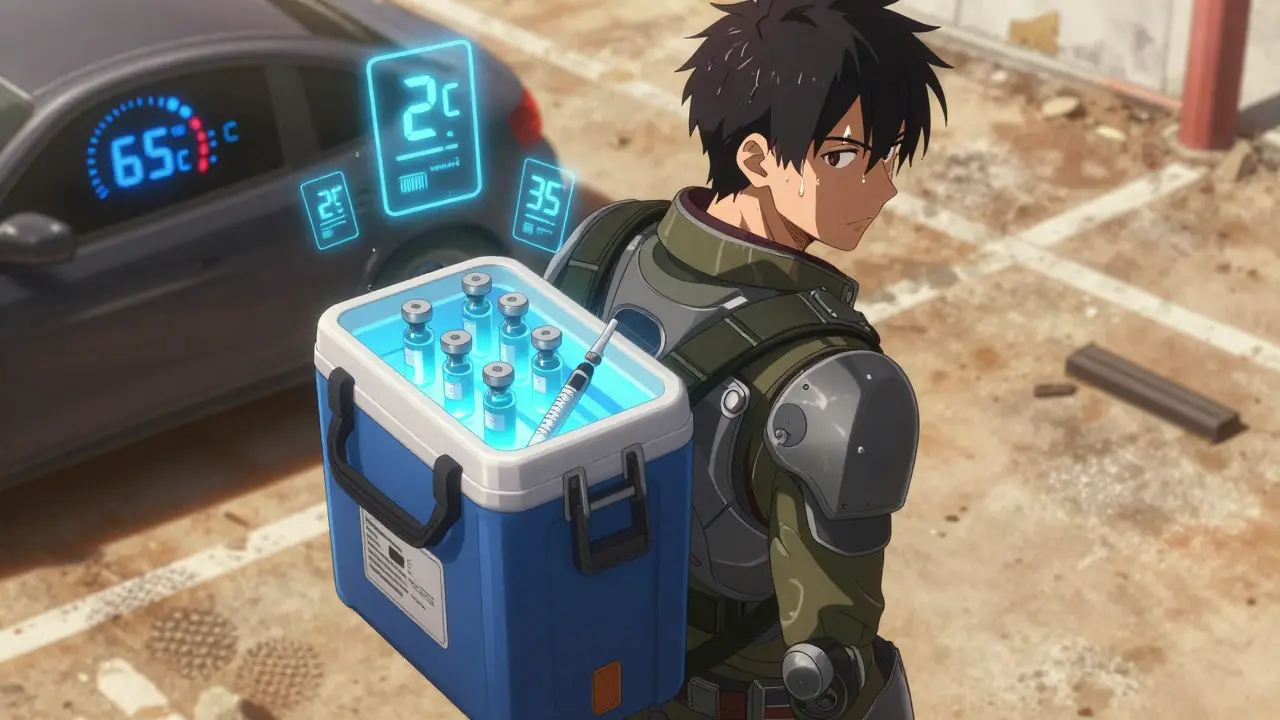
Summer heat is the biggest threat to most travelers. A car dashboard can hit 65°C in the sun. A delivery van? 40°C is normal. Here’s how to stay safe:- Use an insulated cooler bag. Not just any bag-a real one designed for medical use. A standard lunch bag with two frozen gel packs can hold 2°C-8°C for up to 8 hours in 32°C heat.
- Keep it out of direct sunlight. Put it under your seat, in the glove compartment, or between your legs-not on the passenger seat where the sun hits.
- Don’t rely on air conditioning alone. AC cools the air, not the bag. If the car breaks down or you’re stuck in traffic, your meds are still at risk.
- For long trips, consider a portable active cooler like the TempAid 2.0. It runs on USB, holds temperature for 48 hours, and is used by thousands of travelers. It’s heavy (3.2 lbs) and expensive, but it works.
- If you’re flying, keep meds in your carry-on. Checked baggage can sit on tarmacs in 40°C heat for hours. Airlines don’t control cargo temperatures.
Transporting Medications in Cold Weather
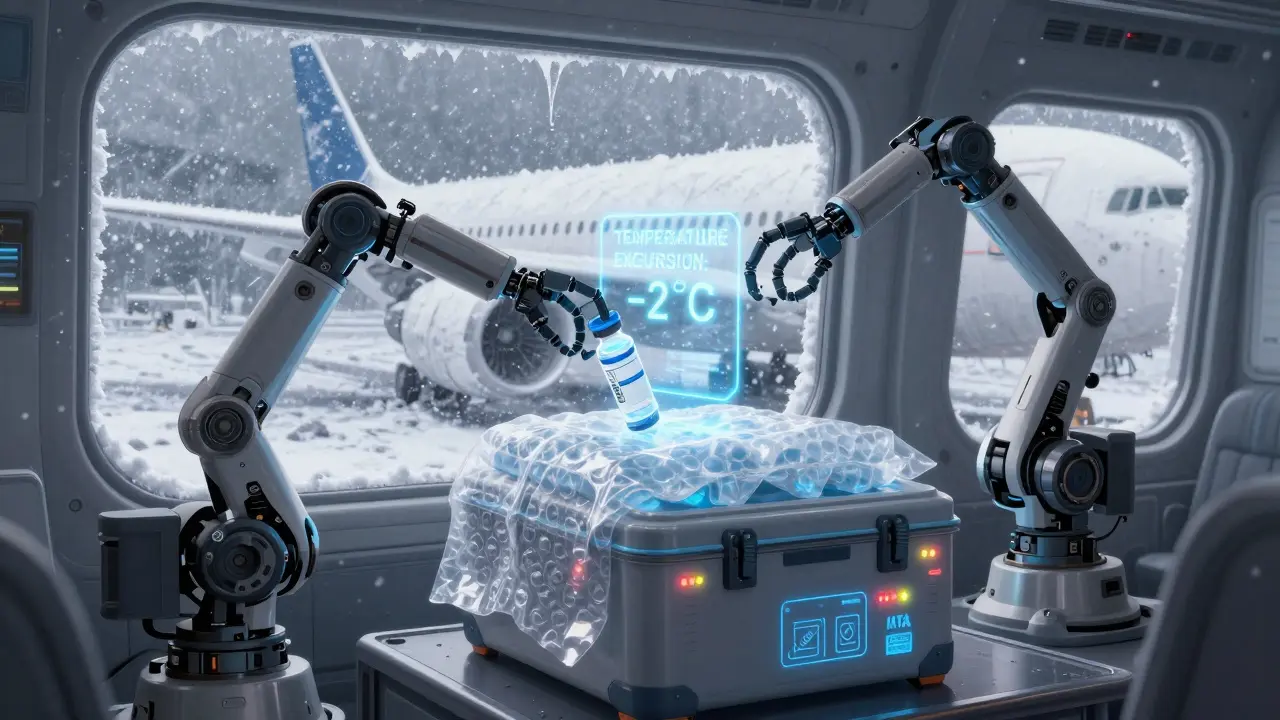
Cold is just as dangerous as heat-for different reasons. Freezing can destroy the structure of liquid medications. Insulin can crystallize. Vaccines can lose their effectiveness. Here’s what to do:- Never let refrigerated meds freeze. Even if your cooler is packed with ice, make sure the meds aren’t touching the ice directly. Use a towel or bubble wrap as a buffer.
- If you’re traveling in winter, keep meds inside your coat or bag-not in an unheated car trunk. Temperatures below -20°C can freeze packages in minutes.
- Use insulated blankets during transfers. If you’re dropping off a vaccine at a clinic, wrap it in a thermal blanket before handing it over. IATA guidelines say no more than 5 minutes of exposure to extreme cold during transfers.
- Pre-cool your transport vehicle. If you’re using a refrigerated van, let it run for at least 30 minutes before loading. Sudden temperature changes cause condensation, which can ruin packaging.
- For long-distance winter travel, consider a hybrid cooler that combines insulation with a small battery-powered heater. These are rare but growing in use among medical transport companies.
What Packaging Actually Works
There are three types of packaging used in professional settings:| Package Type | How It Works | Duration | Best For | Cost |
|---|---|---|---|---|
| Passive (Insulated + Gel Packs) | Uses materials like foam and phase-change materials to slow heat transfer | 24-72 hours | Short trips, air travel, pharmacy deliveries | $10-$30 |
| Active (Battery-Powered Cooler) | Uses electricity to actively cool or heat | Indefinitely (as long as power lasts) | Long trips, road trips, international travel | $150-$400 |
| Hybrid (Insulated + Limited Active) | Combines insulation with a small battery to extend cooling time | 48-96 hours | Medical transport, emergency supplies | $50-$120 |
The Last Mile Is the Most Dangerous
Here’s the truth no one talks about: 43% of temperature excursions happen during the final delivery. Not during the flight. Not during the truck ride. When the driver leaves your package on the porch while you’re at work. A 2023 survey found that 68% of pharmacists had at least one incident in summer where meds were left outside in the heat. If you’re having meds delivered, ask for a signature. Ask for them to be left in a shaded, cool spot. If you’re not home, have them sent to a pharmacy, a friend’s house, or a locker with climate control. If you’re picking up meds yourself, don’t wait. Get them, get in the car, and go. Every extra minute outside increases risk.
What to Do If Your Medication Gets Too Hot or Too Cold
If you suspect your meds were exposed to bad temperatures:- Don’t use them.
- Call your pharmacist or doctor. They can tell you if it’s still safe.
- Keep the packaging. Some manufacturers will replace it if you have proof of exposure.
- Don’t assume it’s fine because it looks normal. Insulin can look clear and still be useless.
Documentation Is Non-Negotiable
If you’re transporting meds professionally, you need temperature logs. If you’re traveling, keep receipts. Keep the packaging. If your insulin was delivered in a cooler with a label showing it was kept at 5°C during transit, that’s proof. The FDA requires records to be kept for three years after a drug expires. Airlines and pharmacies now ask for temperature records for high-risk shipments. If you’re flying with a vaccine, you might be asked to show a temperature log from the pharmacy. Even if you’re just a patient, keeping your meds’ original packaging and the pharmacy receipt gives you proof if something goes wrong.What’s Changing in 2026
The rules are tightening. By 2026, most international shipments will use blockchain-based temperature tracking. That means every temperature change is recorded, time-stamped, and can’t be altered. New guidelines from the WHO will require ultra-cold storage protocols for mRNA vaccines in areas without reliable power. And the FDA is pushing for IoT devices that don’t just record temperature-they predict risk before it happens. But here’s the bottom line: none of this changes what you need to do today. Keep your meds cool. Keep them dry. Don’t leave them in the car. And when in doubt, ask your pharmacist.Can I leave my insulin in the car for a few minutes?
No. Even 15 minutes in a hot car can degrade insulin. In summer, car interiors can reach 60°C. Insulin degrades at 1.2% per hour above 25°C. That means 45 minutes in a 35°C car can reduce its potency by 10%. Always keep it with you, in a cooler bag, and never in the trunk or dashboard.
Is it safe to use ice packs directly against my medication?
No. Direct contact with ice or frozen gel packs can freeze liquid medications like insulin, causing permanent damage. Always use a barrier-like a towel, bubble wrap, or the packaging itself-to separate the meds from the cold source. The goal is to keep it cool, not frozen.
What’s the best way to carry meds on a plane?
Always carry them in your hand luggage. Checked baggage can sit on hot tarmacs for hours. Use a small insulated cooler with two frozen gel packs. Keep the original prescription label and a letter from your doctor. Airlines allow medical items in carry-ons, and TSA won’t stop you if you’re prepared.
Can I use a regular cooler from the grocery store?
A regular cooler works in a pinch, but it’s not reliable. Medical-grade coolers are designed to maintain temperature longer and resist external heat better. A standard cooler might hold 2°C-8°C for 4 hours in 30°C weather. A medical cooler can do it for 24+ hours. For short trips, it’s okay. For long trips or critical meds, invest in a proper one.
What should I do if my medication looks cloudy or has particles in it?
Stop using it. Cloudiness, clumping, or crystals mean the medication has degraded. This is common with insulin after heat exposure. Contact your pharmacist or doctor immediately. Do not inject it. Most manufacturers will replace it if you have documentation of temperature exposure.
Transporting medications in extreme weather isn’t about being careful-it’s about being precise. The science is clear. The risks are real. And the consequences aren’t worth the risk. Whether you’re traveling across the country or just walking to your car, treat your meds like the life-saving tools they are. Keep them cool. Keep them dry. And never assume they’re fine just because they look the same.
Chelsea Deflyss
February 8, 2026 AT 17:56ps: why do pharmacies not warn people about this? they just hand you the pen like it's a candy bar.
Marie Fontaine
February 9, 2026 AT 12:05also never leave meds in the car. ever. not even for "just a sec". i learned this the hard way and now i'm basically a medication ninja. you got this!!
Lyle Whyatt
February 11, 2026 AT 08:57Tatiana Barbosa
February 12, 2026 AT 11:49ps: always ask for a cooler at the pharmacy. they'll give you one. they really will.
Ken Cooper
February 14, 2026 AT 04:04also… why is this not on every prescription bottle?
MANI V
February 15, 2026 AT 20:37if you can’t be bothered to protect your medication, maybe you shouldn’t be taking it.
and yes, i’m talking to you, the person who leaves insulin in the car while you go to Starbucks. you’re not just risking your health - you’re risking everyone around you.
Susan Kwan
February 17, 2026 AT 06:40yeah. that’s the american healthcare system in a nutshell.
Random Guy
February 18, 2026 AT 20:31next day i felt like i was being slowly eaten alive by my own pancreas.
turns out the insulin was toast.
now i carry it in a fanny pack. like a survivalist. because i am.
Ryan Vargas
February 20, 2026 AT 06:28Simon Critchley
February 21, 2026 AT 00:02Also - if you’re flying with insulin, always carry a doctor’s letter AND the original pharmacy label. TSA doesn’t care about your story - they care about paperwork.
Pro tip: Put a sticky note on the cooler that says "LIFE SAVING MEDICATION - DO NOT OPEN." It works. I swear. 🤞
John McDonald
February 21, 2026 AT 20:10it’s not overkill. it’s survival.
Chelsea Cook
February 22, 2026 AT 14:37yeah. we’re all just one hot car ride away from becoming a statistic.
funny how the same people who scream about "personal responsibility" are the ones who don’t fund the infrastructure to make it possible. 🙃
John Sonnenberg
February 23, 2026 AT 06:41...I’ve been leaving it in my glove compartment for two years.
I’m going to cry. I’m going to scream. I’m going to buy ten coolers and hang them from my ceiling like trophies.
Joshua Smith
February 23, 2026 AT 23:04anyone else have a similar setup? is it okay?
Jessica Klaar
February 24, 2026 AT 11:44then we blame the patient.
this article changed how i think about healthcare. it’s not about willpower. it’s about systems. and right now, the system is failing us.