 Dec, 5 2025
Getting a child to take their medicine shouldn’t feel like a daily battle. Yet for many parents, it is. The problem isn’t always that the child refuses - it’s that the medicine tastes awful. Bitter, chemical, metallic - these aren’t just words parents use in frustration. They’re clinical realities that directly impact whether a child finishes their course of antibiotics, asthma meds, or antibiotics. And when they don’t, infections linger, conditions worsen, and hospital visits increase. That’s where flavoring services come in - a simple, proven, and widely available solution that turns medication time from a war zone into a routine.
Why Taste Matters More Than You Think
It’s easy to assume kids just don’t like taking medicine. But research shows it’s not about disobedience - it’s about biology. Children have more sensitive taste buds than adults, especially for bitterness. Many common pediatric medications - like amoxicillin, azithromycin, and Augmentin - are inherently bitter because of their active ingredients. When a child spits out a dose or refuses the next one, it’s not rebellion. It’s a natural reaction to a bad taste that lingers in their mouth for minutes after swallowing. Studies confirm this: over 78% of pediatric patients struggle with treatment because of how their medicine tastes. In one major study, non-compliance dropped from 76% to just 20% when medications were flavored. Another found that when flavoring was added, compliance jumped from 53% to over 90%. That’s not a small improvement. That’s the difference between a child recovering and a child ending up back in the ER. The FDA recognizes this too. They’ve stated that palatability is a key factor in successful therapeutic outcomes. If a child won’t take the medicine, it doesn’t matter how effective it is on paper.How Flavoring Services Actually Work
Flavoring services aren’t magic. They’re pharmacy compounding - the same process pharmacists use to make custom doses or change forms of medication. In this case, a trained pharmacist adds a safe, food-grade flavoring agent directly into the liquid medication. The flavoring is sugar-free, dye-free, and designed not to interfere with the drug’s chemistry or potency. It’s not a syrup or a sweetener - it’s a precise additive that masks bitterness without altering dosage. The most commonly re-flavored medications are antibiotics: Amoxicillin, Augmentin, Azithromycin, Cefdinir, and Clindamycin. These are the ones parents are most likely to struggle with. The top flavors kids prefer? Grape, bubblegum, strawberry, watermelon, and cherry. These aren’t random choices. They’re based on years of feedback from children and parents alike. At pharmacies like Intermountain Healthcare, the process takes about one to two minutes. The pharmacist asks the parent or child which flavor they’d like, adds the drop or two of flavoring, shakes it gently, and hands it over. The cost? Just $1.50 per prescription. No special equipment. No prescription change. Just better taste.Why Home Hacks Don’t Work
Many parents try to hide the taste by mixing medicine with juice, applesauce, or chocolate syrup. It seems smart - until it backfires. Mixing medication with food or drink can change how the body absorbs it. Some antibiotics lose effectiveness when mixed with dairy. Others become too thick, making accurate dosing impossible. A child might spit out the entire spoonful of applesauce because the medicine still tastes bad. Or worse - they eat the applesauce but leave the medicine behind. Flavoring services eliminate these risks. The flavoring is added directly to the medication in a controlled way, ensuring the full dose is delivered as prescribed. No guessing. No wasted medicine. No altered absorption.
Real Impact: From Battles to Bubblegum
Parents don’t just report better compliance - they report life-changing shifts. One mother said her child, who used to cry and run away at the sight of the medicine bottle, now asks for his medicine because it tastes like bubblegum. Another parent described how her daughter, who had refused her asthma inhaler for weeks, suddenly started taking it after the pharmacist added a strawberry flavor to the liquid version. Germantown Pharmacy in Mississippi started offering flavoring services and saw immediate results. Not only did adherence improve, but families started recommending the pharmacy to friends. One parent said, “It’s not just about taste - it’s about giving my child some control. Letting them pick the flavor makes them feel like part of the process.” This isn’t anecdotal. It’s measurable. When flavoring is available, families are more likely to refill prescriptions on time. They’re less likely to skip doses. And they’re far less likely to call the doctor in panic because the child won’t take their meds.Who Offers This Service - And How to Find It
Flavoring services are now standard at most community pharmacies across the U.S., especially those that serve families. Chains like CVS, Walgreens, and independent pharmacies with pediatric-focused care often offer it. Intermountain Healthcare rolled it out across all their pharmacies in 2023. FLAVORx is the most recognized brand, but many pharmacies use their own systems or partner with similar providers. You don’t need a special request. Just ask. When picking up a liquid prescription for your child, say: “Can you add a flavor to this?” If the pharmacist says no, ask if they can order it or refer you to a pharmacy that does. Most will be happy to help. Some pharmacies even let kids pick their flavor from a chart with pictures - grape, watermelon, bubblegum - turning a stressful moment into a small win.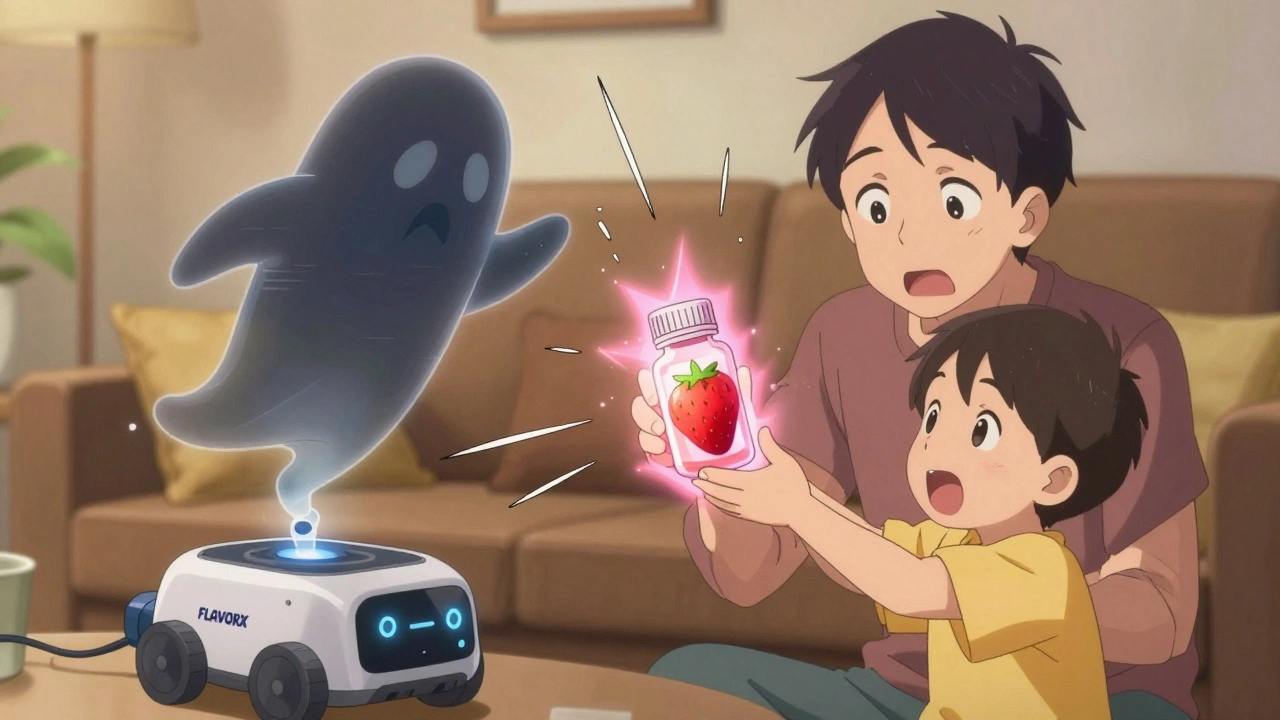
Limitations and What It Can’t Fix
Flavoring isn’t a cure-all. It doesn’t work for every medication. Some formulations are too thick, too acidic, or chemically unstable when mixed with flavoring agents. Pharmacists screen each prescription to make sure it’s safe to flavor. It also doesn’t solve problems caused by other factors - like complicated dosing schedules, side effects like nausea, or fear of needles. But for the most common barrier - taste - it’s the most effective tool available. Some children develop strong preferences. One kid might love grape so much that they refuse to take any other flavored medicine. That’s rare, but it happens. Pharmacists can help by offering alternatives or rotating flavors between courses. And while flavoring improves adherence, it doesn’t replace the need for better drug design. Researchers are now working on next-generation taste-masking technologies - like microencapsulation and sustained-release coatings - that could make future medications inherently palatable without added flavoring.The Bigger Picture: Adherence Is Healthcare
Medication adherence isn’t just a parenting issue. It’s a public health issue. The American Pharmacists Association says it plainly: medicines can’t work if people don’t take them. In pediatrics, non-adherence leads to antibiotic resistance, longer illnesses, emergency visits, and higher costs. Flavoring services are one of the few interventions that directly improve outcomes, reduce stress, and cost almost nothing. They’re easy to implement, widely accepted, and backed by solid data. This isn’t about making medicine sweet. It’s about making care human.When a child takes their medicine without a fight, everyone wins. The child gets better faster. The parent gets peace of mind. The doctor gets the results they need. And the pharmacy? They become the place families trust - not just for prescriptions, but for care that actually works.
brenda olvera
December 6, 2025 AT 04:16My kid used to scream every time I pulled out the amoxicillin. Then we tried grape flavoring at our local pharmacy and it was like night and day. Now he asks for his medicine like it’s candy. $1.50 and a two-minute wait saved us weeks of tears and missed doses.
Seriously, why isn’t this standard everywhere?
Akash Takyar
December 6, 2025 AT 07:27While the anecdotal evidence presented is compelling, one must consider the broader pharmacological implications of flavoring agents in pediatric formulations. The addition of non-active ingredients, even if food-grade, may introduce variability in bioavailability, particularly in patients with metabolic sensitivities. A randomized, double-blind, placebo-controlled study would provide more robust validation than observational reports.
pallavi khushwani
December 7, 2025 AT 10:45I’m from India, and here we just mix meds with jam or sugar-no one even thinks about flavoring services. But reading this made me realize we’re just lucky if the kid swallows it without choking. No one talks about how bitter these drugs are until you’re the one holding the syringe and your child is sobbing. It’s not about being stubborn-it’s biology. And honestly? It’s sad we didn’t think of this sooner.
Maybe it’s not about fixing the kid… it’s about fixing the system.
Brooke Evers
December 8, 2025 AT 11:05I’ve been a pediatric nurse for 14 years, and let me tell you-taste is the #1 reason parents skip doses or stop antibiotics early. I’ve seen kids with pneumonia come back because they couldn’t handle the bitterness of azithromycin. And then I saw a pharmacy in Ohio start offering flavoring, and within three months, their readmission rates for respiratory infections dropped by 40%. It’s not just about comfort-it’s about survival. Why are we still treating this like a minor inconvenience instead of a critical intervention? It’s not a luxury. It’s basic care.
And yes, I’ve cried with parents over this. More than once.
Saketh Sai Rachapudi
December 9, 2025 AT 01:15USA again with their overpriced gimmicks. In India we just use jaggery and make the kid drink it fast. No need for fancy flavoring services. This is just capitalism turning medicine into a candy shop. Why not just give them lollipops instead? You want compliance? Teach kids discipline. Not make medicine taste like a cartoon.
joanne humphreys
December 9, 2025 AT 09:37I’m curious-do these flavoring agents work the same for all age groups? I have a toddler and a 10-year-old, and their preferences are wildly different. My little one loves bubblegum, but my older kid thinks it’s babyish and only takes it if it’s sour cherry. Do pharmacies adjust for that? Or is it just ‘pick one from the chart’ and hope for the best?
Kay Jolie
December 10, 2025 AT 16:48Let’s be real-this isn’t about flavoring. It’s about the commodification of pediatric empathy. We’ve turned the visceral, biological aversion to bitterness into a branded consumer experience-FLAVORx™, because nothing says ‘healthcare innovation’ like a neon-colored dropper and a kid choosing between grape and cotton candy.
It’s brilliant. It’s absurd. It’s capitalism’s answer to systemic neglect. And honestly? I’m here for it. If a $1.50 flavor drop turns a trauma into a ritual, then yes-give me more micro-encapsulated dignity.
Dan Cole
December 11, 2025 AT 11:17Let’s not romanticize this. Flavoring doesn’t fix the root problem: pharmaceutical companies design drugs for adult metabolism and then slap a bitter pill on children without regard for palatability. The fact that we need a pharmacy to ‘fix’ what should’ve been engineered in the lab in the first place is a failure of drug development, not a triumph of compounding. This is a Band-Aid on a ruptured artery. And yes, I’ve read the FDA guidelines. They’re vague. They’re reactive. And they’re not enough.
Billy Schimmel
December 11, 2025 AT 23:55So you’re telling me the solution to kids not taking medicine is… giving it a flavor? Wow. Groundbreaking. Next you’ll tell me we should add sprinkles to insulin.
...Actually, now that I think about it, that might work.