 Jan, 31 2026
Before there were cheap pills on the shelf, there was chaos
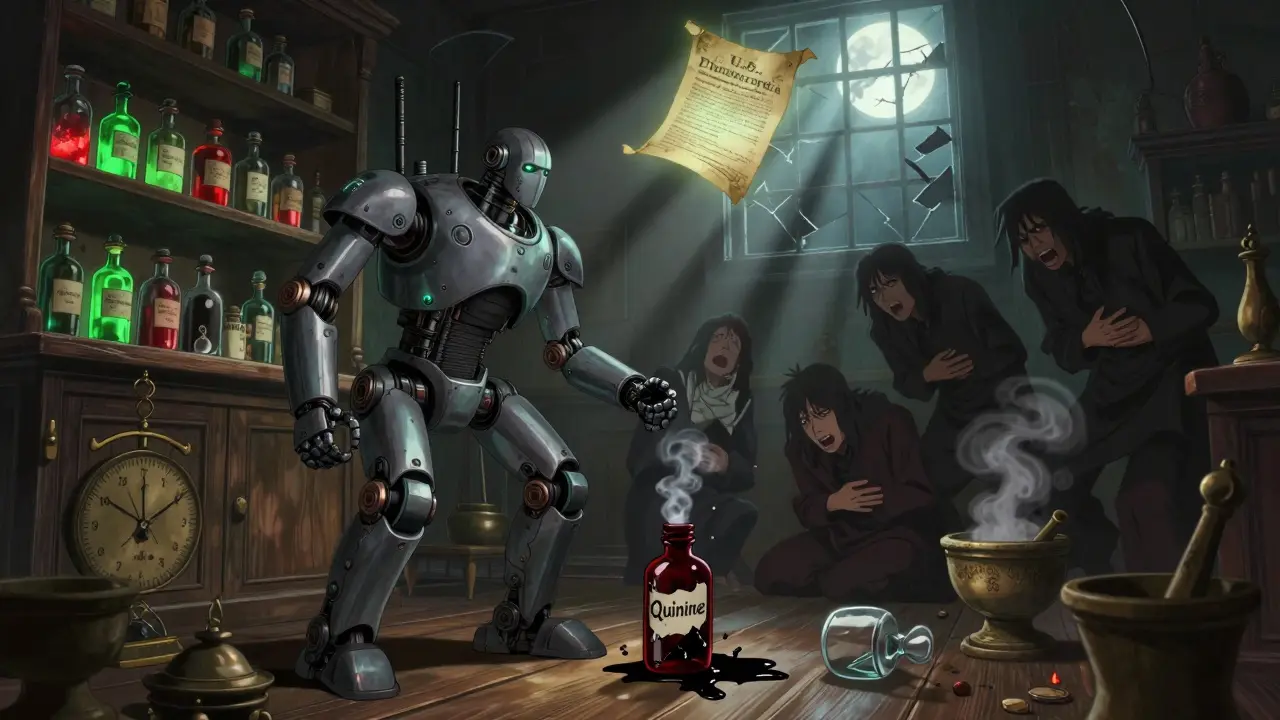
In the 1800s, if you bought medicine in the U.S., you had no idea what you were getting. Pills labeled "quinine" might contain chalk. "Opium" could be laced with lead. There were no rules. No testing. No oversight. People got sick-or died-because drugs were unregulated, untested, and often fake. The first real step toward fixing this came in 1820, when eleven doctors met in Washington, D.C., and wrote down what a real drug should look like. They called it the U.S. Pharmacopeia. It wasn’t law, but it was a start. For the first time, there was a shared standard: what quinine, morphine, and other medicines were supposed to contain.
The first law that gave the government power to act
By 1848, the U.S. was importing drugs from Europe, and many were spoiled or outright poisonous. Congress passed the Drug Importation Act, giving Customs agents the right to stop bad drugs at the border. It was the first time the federal government had any real authority over medicine. But it didn’t fix the problem inside the country. Counterfeiters still sold fake pills. Doctors still didn’t know what they were prescribing. In 1888, the American Pharmaceutical Association stepped in with the National Formulary, a list of approved ingredients and recipes. It helped, but it was voluntary. No one had to follow it.
The poison that changed everything
In 1937, a company in Tennessee sold a liquid antibiotic called Elixir Sulfanilamide. To make it taste better, they mixed it with diethylene glycol-a chemical used in antifreeze. Over 100 people, mostly children, died. The public was horrified. Congress responded fast. In 1938, they passed the Federal Food, Drug, and Cosmetic Act. For the first time, drug makers had to prove their products were safe before selling them. The FDA, which had existed as a small office since 1906, became a real regulator. This law laid the foundation for every drug rule that came after.
Prescriptions, patents, and the rise of brand names
In 1951, the Durham-Humphrey Amendment split drugs into two categories: those you could buy off the shelf and those you needed a doctor’s prescription for. Suddenly, brand-name companies had a new advantage. They could control who got their drugs and charge more. By the 1960s, brand-name drugs dominated the market. But there was a problem: prices kept climbing. In 1962, after the thalidomide scandal (a drug that caused birth defects in Europe), Congress passed the Kefauver-Harris Drug Amendments. Now, drug makers had to prove their drugs didn’t just work-they worked better than nothing. And they had to prove it with real clinical trials. This made developing new drugs more expensive. It also made it harder for smaller companies to compete. But it didn’t help the price of generics yet. That came later.
The game-changer: The Hatch-Waxman Act
In 1984, everything changed. The Drug Price Competition and Patent Term Restoration Act, better known as the Hatch-Waxman Act, created the modern system for generic drugs. Before this, generic makers had to run full clinical trials-just like the brand-name company. That cost millions. Hatch-Waxman said: if you can prove your pill is bioequivalent-meaning it breaks down the same way in the body-you don’t need to test it again on people. You just need to show it matches the brand-name drug in strength, speed, and absorption. This was the birth of the Abbreviated New Drug Application, or ANDA. Suddenly, making generics was fast and cheap. Within a decade, generic use jumped from 19% of prescriptions to over 50%. Today, it’s over 90%.
How generics saved the U.S. healthcare system billions
Generics aren’t just cheaper-they’re a financial lifeline. In 2021, they saved the U.S. healthcare system $373 billion. Over the last ten years, that’s more than $3.7 trillion. The Congressional Budget Office found generics cut prescription costs by 80% to 85% compared to brand names. In 2022, generics made up 90.5% of all prescriptions filled-but only 23.4% of total drug spending. That means for every dollar spent on drugs, only 23 cents went to generics. The rest went to brand names. That’s the power of competition. When a patent expires and generics enter the market, prices often drop by 80% within a year. Some drugs fall to pennies per pill.
The dark side: shortages, price spikes, and corporate tricks
But it’s not all smooth sailing. Between 2018 and 2022, the FDA recorded 1,234 drug shortages. Sixty-five percent of them involved generic drugs. Why? Because making cheap pills isn’t profitable enough for big companies. When a generic drug sells for a few cents, manufacturers cut corners. They move production overseas to save money. Many active ingredients now come from China and India. The FDA says 80% of API factories are outside the U.S. When a factory fails inspection-or gets hit by a flood, a power outage, or a pandemic-supply chains break. And when supply drops, prices spike. In one case, the price of a common antibiotic jumped from $20 to $1,800 per bottle in just a few years. Between 2013 and 2017, 15% of generic drugs saw price increases over 100%, even as most others got cheaper. That’s not competition. That’s market manipulation.
How brand-name companies block generics
Even with Hatch-Waxman, brand-name companies found ways to delay competition. One trick? File a lawsuit against the generic maker the moment they apply. That triggers a 30-month automatic delay. Companies have used this over 1,000 times to push back generic entry by years. Another trick? Refusing to sell samples of their drug to generic makers. Without the original, you can’t test your copy. That’s why Congress passed the CREATES Act in 2019. It lets the FDA force brand-name companies to provide samples. Since then, the agency has taken 27 enforcement actions under this law.
The future: Biosimilars and global supply chains
The next frontier isn’t pills anymore-it’s biologics. These are complex drugs made from living cells, like insulin or cancer treatments. They’re expensive, often costing over $100,000 a year. The FDA has started approving biosimilars-generic versions of biologics. They’re harder to make and test, but they’re coming. By 2027, experts predict biosimilars will make up a growing slice of the market. But the real challenge remains: supply chains. The U.S. depends on foreign factories for 80% of its active ingredients. The FDA now oversees 13,000 manufacturing sites worldwide. And they’re still behind. In 2012, it took 30 months to approve a generic drug. Today, thanks to the Generic Drug User Fee Amendments (GDUFA), it takes 10 months. Approval rates jumped from 45% to 95%. But the system is still fragile. One factory failure can leave millions without medicine.
Why this matters to you
When you fill a prescription for a generic drug, you’re not just saving money. You’re using a system built on decades of law, scandal, reform, and innovation. That pill on the shelf? It’s the result of 200 years of public health battles. It’s the reason your insulin costs $30 instead of $300. It’s why your child’s antibiotics don’t bankrupt your family. But it’s also why you might still wait weeks for a drug that should be in stock. The system works-most of the time. But it’s only as strong as its weakest link: a factory in India, a lawsuit in Delaware, or a price hike in a small town with no competition. The history of generics isn’t just about pills. It’s about power, profit, and who gets to live.
Are generic drugs really the same as brand-name drugs?
Yes. The FDA requires generic drugs to have the same active ingredient, strength, dosage form, and route of administration as the brand-name version. They must also be bioequivalent, meaning they work the same way in your body. The only differences are in inactive ingredients like fillers or dyes, which don’t affect how the drug works. Generics are not cheaper because they’re lower quality-they’re cheaper because they don’t need to repeat expensive clinical trials.
Why are some generic drugs hard to find?
Many generic drugs are made by a handful of manufacturers, often overseas. If one factory has a quality issue, shuts down, or stops producing a low-margin drug, shortages happen. The FDA reports that 65% of drug shortages between 2018 and 2022 involved generics. Low-profit drugs, like old antibiotics or injectables, are especially vulnerable because companies don’t make enough money to keep multiple factories running.
Can a generic drug be less effective?
No. The FDA requires generics to be as effective as brand-name drugs. They must deliver the same amount of active ingredient into your bloodstream at the same rate. If a generic doesn’t meet these standards, it’s rejected. There have been rare cases where patients report differences, but studies show these are usually due to placebo effects or unrelated health changes-not the drug itself.
Why do generic drug prices sometimes spike?
When only one or two companies make a generic drug, competition disappears. If one manufacturer stops producing it, the other can raise prices. Between 2013 and 2017, 15% of generic drugs saw price increases over 100%. This often happens with older drugs that have no patent protection but low production volume. The FDA calls these "micro-market" shortages, and they’re one of the biggest challenges today.
How does the FDA ensure generic drugs are safe?
The FDA inspects every manufacturing facility that makes generics-over 13,000 worldwide. Each generic drug must pass strict bioequivalence testing. The agency also monitors adverse events and can pull a drug off the market if safety issues arise. Since 2012, the Generic Drug User Fee Amendments (GDUFA) have helped speed up reviews and improve oversight. Today, 95% of generic applications are approved, up from 45% in 2012.
Melissa Melville
February 1, 2026 AT 12:06Deep Rank
February 3, 2026 AT 08:47Naomi Walsh
February 4, 2026 AT 04:21Bob Cohen
February 4, 2026 AT 17:46Aditya Gupta
February 4, 2026 AT 20:41Jaden Green
February 5, 2026 AT 04:46Angel Fitzpatrick
February 5, 2026 AT 12:48Donna Macaranas
February 6, 2026 AT 16:44Rachel Liew
February 6, 2026 AT 19:36