 Jan, 10 2026
Barrett’s Esophagus isn’t something most people hear about until they’re diagnosed. But if you’ve had heartburn for years-especially if it’s happening several times a week-it’s something you need to understand. This isn’t just acid reflux. It’s a change in the lining of your esophagus, one that can quietly turn into cancer if left unchecked. The good news? We now have powerful tools to stop it before it goes too far. The bad news? Many people don’t know they’re at risk until it’s too late.
What Exactly Is Barrett’s Esophagus?
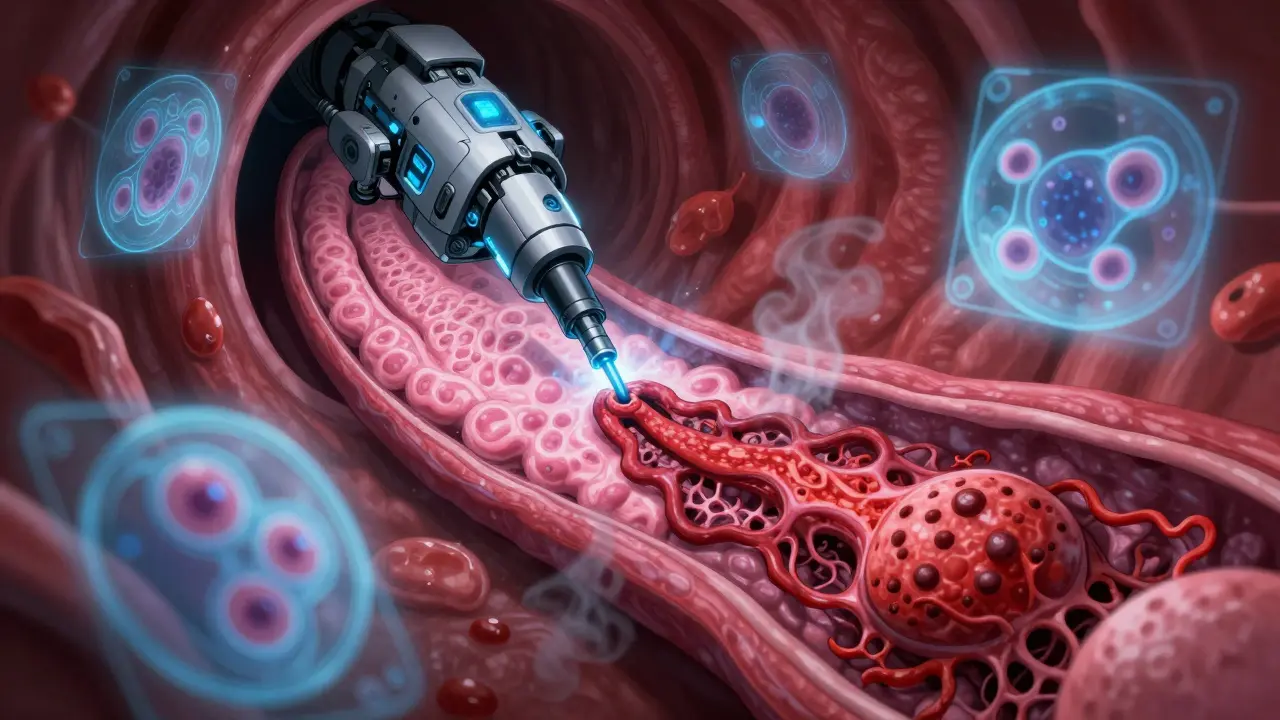
Barrett’s Esophagus happens when the normal tissue lining your esophagus-soft, pink, and flat-gets replaced by a tougher, redder tissue that looks more like the lining of your intestines. This change, called metaplasia, is your body’s attempt to protect itself from long-term acid damage. But this new tissue isn’t harmless. It’s the only known precursor to esophageal adenocarcinoma, a deadly form of cancer that’s become far more common over the last 50 years.
It doesn’t happen overnight. You need chronic GERD-heartburn or regurgitation at least once a week for five years or more-to be at risk. About 1 in 10 people with long-term GERD develop Barrett’s. Men are more than twice as likely as women. White individuals have a higher risk than South Asian populations. If you’re over 50, carry extra weight around your middle, or smoke, your odds go up even more. And if someone in your family has had Barrett’s or esophageal cancer, your risk jumps to nearly 1 in 4.
The scary part? Most people with Barrett’s feel no different than they did with plain GERD. There’s no new pain, no new symptoms. That’s why screening with an endoscopy is critical for anyone with long-standing reflux. Without it, you might never know you’re carrying a ticking time bomb.
How Fast Does Barrett’s Turn Into Cancer?
Not everyone with Barrett’s will get cancer. In fact, most won’t. But the risk isn’t zero. For people with no dysplasia-meaning no abnormal cell changes-the chance of developing cancer is about 0.2% to 0.5% per year. That sounds small, but over 10 years, it adds up.
The real danger shows up when dysplasia appears. Dysplasia means your cells are starting to look abnormal under the microscope. There are two levels: low-grade (LGD) and high-grade (HGD). If you have LGD, your risk of cancer goes up fivefold. If you have HGD, your risk jumps to between 23% and 40% per year. That’s not a slow creep-it’s a sprint toward cancer.
Length matters too. If your Barrett’s segment is longer than 3 centimeters-especially over 10 cm-you’re at much higher risk. So is having a hiatal hernia, smoking, or still having acid exposure even after taking proton pump inhibitors (PPIs). One study found that people with persistent acid reflux despite treatment had over seven times the risk of progression.
And here’s something many don’t realize: not all dysplasia is the same. Studies show that community pathologists agree with expert GI pathologists on a low-grade diagnosis only 55% of the time. That means you could be told you have dysplasia when you don’t-or told you’re fine when you’re not. That’s why getting a second opinion from a specialist is often the smartest move.
What Are the Ablation Options?
If you’ve been diagnosed with dysplasia, especially high-grade, you’re not stuck waiting for cancer to develop. There are proven ways to remove or destroy the abnormal tissue before it turns malignant. The goal isn’t just to kill the bad cells-it’s to let healthy tissue grow back in its place.
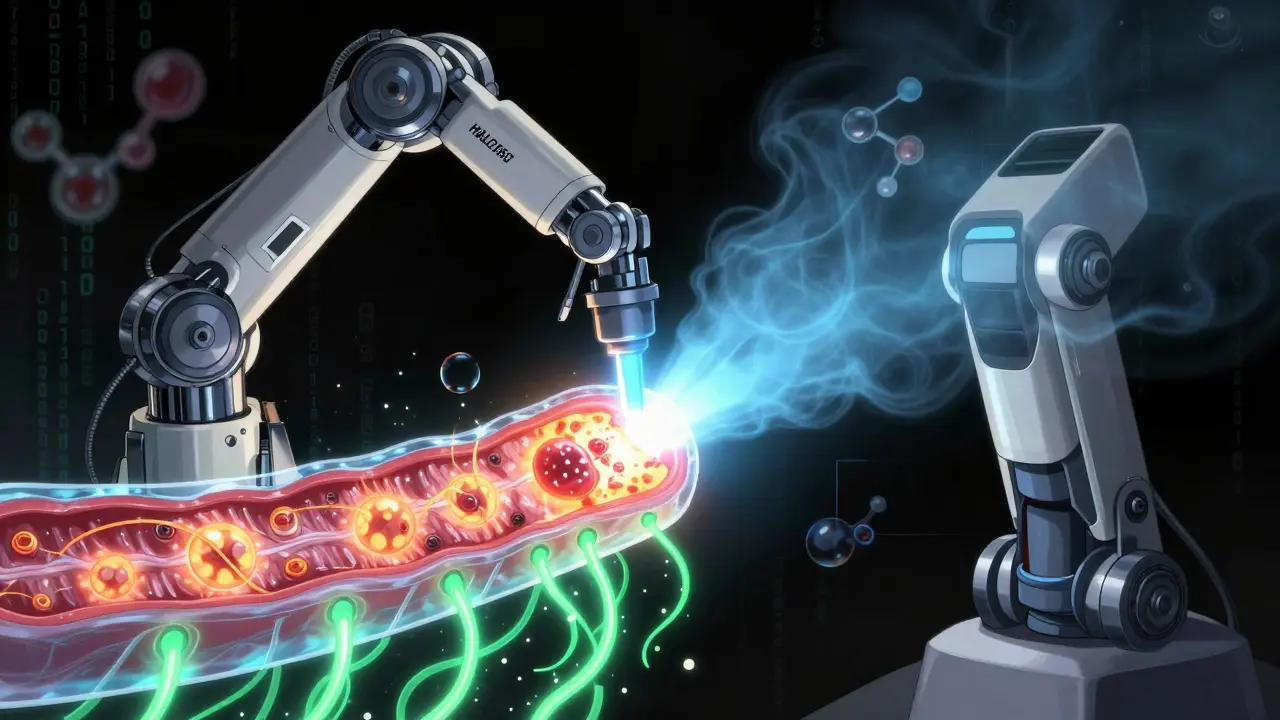
Radiofrequency Ablation (RFA) is the gold standard. It uses controlled heat delivered through a balloon or catheter to burn off the abnormal lining. The HALO360 system treats the whole circumference of the esophagus, while HALO90 targets visible spots. In clinical trials, RFA cleared dysplasia in nearly 88% of patients and removed the abnormal tissue entirely in 77% after one year. It’s now used in 78% of all ablation procedures in the U.S.
Most people need two to three sessions, spaced a few months apart. It’s not painful during the procedure-you’re sedated-but afterward, you might feel chest discomfort for a few days. The biggest side effect? Strictures. About 6% of patients develop narrowing of the esophagus, requiring one or more dilation procedures. Some patients report these dilations are more uncomfortable than the original symptoms.
Cryoablation uses extreme cold instead of heat. A balloon delivers nitrous oxide at -85°C, freezing the tissue. It’s newer but growing fast. In trials, it cleared dysplasia in 82% of cases. One big advantage? It’s gentler on tissue that’s already scarred or narrowed. If you’ve had a stricture before, cryoablation has a much lower risk of causing another one-just 1.1% compared to 8.3% with RFA. It’s also less expensive per session, though you might need more treatments over time.
Photodynamic Therapy (PDT) used to be common. It involves injecting a light-sensitive drug, waiting 48 hours, then shining a laser on the esophagus. It works-about 77% success rate-but the side effects are rough. You can’t be exposed to sunlight for weeks, or you’ll get severe burns. Strictures happen in 17% of cases. Because of this, it’s rarely used today.
Endoscopic Mucosal Resection (EMR) is different. It’s not ablation-it’s removal. If you have a visible bump or lesion, your doctor can lift and cut it out. It’s very effective for early tumors, with a 93% success rate for small lesions. But it’s invasive. Bleeding happens in 5-10% of cases, and perforation, though rare, is possible. EMR is usually done before ablation, not instead of it.
Which Treatment Is Right for You?
There’s no one-size-fits-all answer. But here’s what the guidelines say:
- If you have high-grade dysplasia, ablation is strongly recommended. The risk of cancer is too high to wait.
- If you have low-grade dysplasia, you have options. Some doctors still recommend surveillance with repeat endoscopies every 6-12 months. But newer data shows that ablation reduces cancer risk by 90% compared to watching and waiting. Many experts now recommend treating LGD, especially if you’re young, have long-segment Barrett’s, or have other risk factors like smoking.
- If you have no dysplasia, you probably don’t need ablation. Just manage your GERD with PPIs and get checked every 3-5 years. Over-treatment is a real problem-up to 30% of ablations are done on people who don’t need them.
Here’s how to decide:
- Choose RFA if you want the most proven results, have a normal esophagus without strictures, and can handle the possibility of dilation later.
- Choose cryoablation if you’ve had prior strictures, want fewer side effects, or your doctor recommends it for your specific case.
- Avoid PDT unless no other options are available-it’s outdated and too risky.
Cost-wise, RFA runs about $12,500 per session. Cryoablation is cheaper at $9,850. But RFA usually needs fewer repeat treatments, so over five years, the total cost is nearly the same. Insurance typically covers both if you have confirmed dysplasia.
What Happens After Treatment?
Ablation isn’t a one-and-done fix. You still need to take PPIs daily-even after the abnormal tissue is gone. Acid still causes damage, and without medication, Barrett’s can come back. One 2023 study showed that doubling your PPI dose (esomeprazole 40mg twice daily) cuts recurrence risk from 25% down to just 8% over three years.
You’ll also need follow-up endoscopies. After RFA, you’ll get one at 3 months, then 6, 12, and 24 months. Biopsies are taken using the Seattle protocol-four-quadrant samples every 1-2 cm-to make sure nothing was missed. If all looks good after two years, you might switch to yearly checks.
Some people worry about long-term effects. The good news? Studies show no increase in esophageal cancer after successful ablation. In fact, the risk drops to near zero. And many patients report big improvements in reflux symptoms. One Reddit user wrote: “After cryoablation, my chronic cough from reflux disappeared. I hadn’t realized how much it was affecting me.”
Why Access to Care Still Matters
Even with these advances, not everyone gets the care they need. In big city hospitals, 85% offer ablation. In rural areas, it’s only 42%. That gap means people in small towns are 2.3 times more likely to die from esophageal cancer than those in cities.
Why? Because ablation requires specialized equipment, trained endoscopists, and pathology support. Not every GI practice has it. If you’re being told you have dysplasia but your doctor doesn’t offer ablation, ask for a referral to a center that does. The American Society for Gastrointestinal Endoscopy has a directory of certified providers.
And here’s something new: AI is stepping in. Google Health’s pilot system detected dysplasia with 94% accuracy-higher than most community endoscopists. In the next few years, AI-assisted endoscopy could become standard, helping catch more cases early.
The future is promising. New devices are coming, like the HALO460 system for longer Barrett’s segments and real-time cryoablation monitors. Molecular tests that detect cancer-linked DNA changes might soon replace random biopsies, cutting down on unnecessary procedures by 30%.
But right now, the best thing you can do is know your risk. If you’ve had GERD for years, talk to your doctor about an endoscopy. If you’ve been diagnosed with dysplasia, don’t wait. Treatment works. It’s not perfect, but it’s the best shot we have at stopping cancer before it starts.
Can Barrett’s Esophagus go away on its own?
No, Barrett’s Esophagus doesn’t reverse itself without treatment. The abnormal tissue stays unless it’s physically removed or destroyed. Even if your reflux symptoms improve with diet or medication, the metaplastic lining remains. That’s why endoscopic ablation is necessary for dysplasia-medications alone won’t eliminate the cancer risk.
Is ablation painful?
The procedure itself isn’t painful-you’re sedated. Afterward, most people feel mild chest soreness or difficulty swallowing for a few days, similar to a bad sore throat. The real discomfort often comes later, if you develop a stricture. Dilation procedures can be uncomfortable, and some patients describe them as worse than the original symptoms. But these are manageable with medication and proper follow-up.
Do I still need to take PPIs after ablation?
Yes, absolutely. Even after all abnormal tissue is gone, acid reflux can cause Barrett’s to return. Most experts recommend continuing a proton pump inhibitor daily, and some suggest doubling the dose (like esomeprazole 40mg twice daily) to reduce recurrence risk by more than half. Stopping PPIs after treatment is one of the biggest reasons Barrett’s comes back.
How many ablation sessions will I need?
Most people need two to three sessions, spaced three to six months apart. The number depends on how much tissue is affected and how well your body responds. RFA often clears the tissue faster, while cryoablation may require more sessions. Your doctor will use follow-up biopsies to confirm when the abnormal tissue is fully gone.
Can I drink alcohol after ablation?
Yes, alcohol doesn’t increase your risk of Barrett’s progression or recurrence, unlike smoking or obesity. However, alcohol can worsen reflux symptoms, so it’s still wise to limit it. The focus should be on managing acid exposure-not avoiding alcohol.
What if I don’t want ablation?
If you have low-grade dysplasia, surveillance with repeat endoscopies every 6-12 months is an option. But studies show that without treatment, 1 in 5 people with LGD will develop cancer within 5 years. For high-grade dysplasia, skipping ablation carries a 25% or higher chance of cancer within a year. The risk of the procedure is low compared to the risk of waiting.
Is Barrett’s Esophagus hereditary?
Yes, family history matters. If a first-degree relative has Barrett’s Esophagus or esophageal adenocarcinoma, your risk increases to about 23%. This suggests a genetic component, though the exact genes aren’t fully understood yet. If you have a family history and you’ve had GERD for more than 5 years, screening with endoscopy is strongly recommended.
What Comes Next?
If you’re reading this because you’ve been diagnosed, don’t panic. You’re not alone, and you’re not out of options. The tools to prevent cancer are here. The challenge now is making sure everyone who needs them can get them.
Start by talking to your doctor about your exact diagnosis-ask if it’s confirmed by an expert GI pathologist. Ask if you’re a candidate for ablation. Ask what method they recommend and why. And if you’re unsure, get a second opinion at a center that specializes in Barrett’s.
The goal isn’t just to survive. It’s to live without fear. With the right care, Barrett’s Esophagus doesn’t have to be a death sentence. It can be a turning point-a moment you choose to take control before it’s too late.
Sam Davies
January 10, 2026 AT 21:04Also, did you know your PPIs are basically just expensive antacids with a fancy label? Still, I'll take it over the 17% stricture rate. Who doesn't love a good esophageal tourniquet?
Alex Smith
January 10, 2026 AT 23:48Also, get a second opinion on your pathology. My first read said LGD. Second expert said 'no dysplasia, just inflammation.' Saved me from unnecessary ablation.
Michael Patterson
January 12, 2026 AT 22:33Matthew Miller
January 13, 2026 AT 01:56Madhav Malhotra
January 13, 2026 AT 03:38Priya Patel
January 14, 2026 AT 17:01But then I read about cryoablation and how it's gentler?? And that you can still drink alcohol??
Okay. I'm getting a second opinion. And I'm telling my mom to get screened too. She's had GERD since the 90s. I love you, Mom. Don't be like me. Get checked.
Jennifer Littler
January 16, 2026 AT 09:09Sean Feng
January 17, 2026 AT 12:26Priscilla Kraft
January 19, 2026 AT 06:25Also, cryoablation is way less scary. If you’ve had a stricture before, go for that. Seriously.
Vincent Clarizio
January 20, 2026 AT 02:10Christian Basel
January 21, 2026 AT 06:00Roshan Joy
January 22, 2026 AT 01:19Adewumi Gbotemi
January 22, 2026 AT 23:38Jason Shriner
January 24, 2026 AT 23:00