 Jun, 16 2026
Travel Medication Readiness Calculator
Follow the 6-week preparation timeline to ensure you have all necessary documents and permits for traveling with controlled medications.
Week 6: Request Travel Letter
Contact your prescribing physician to request a letter with full details (brand/generic names, dosage, indication).
Week 5: Research Destination Laws
Check embassy websites for banned substances and special permit requirements (e.g., Japan's Yakkan Shoumei).
Week 4: Apply for Government Certificates
Submit applications for required import certificates (can take up to 2 weeks). Do not skip this if required!
Week 2: Pick Up Medications
Get prescriptions filled in original containers with clear, legible pharmacy labels matching your passport name.
Week 1: Assemble Travel Kit
Pack doctor’s letter, prescription copies, and meds in carry-on. Save digital backups on your phone.
Readiness Score
0/5 Steps Completed
Current Status
Start by requesting your travel letter from your doctor.
Imagine standing in a long line at customs, your heart pounding as an officer pulls out a bottle of pills from your bag. You have the prescription, but you forgot the doctor's note. Suddenly, what should be a simple trip turns into a legal nightmare involving detention, confiscation, or even deportation. This isn't just a worst-case scenario; it happens to thousands of travelers every year. If you rely on controlled medications like ADHD stimulants, strong painkillers, or anxiety meds, understanding how to document them correctly is not optional-it is essential for your safety and freedom.
The global landscape for traveling with medicine has tightened significantly. Governments are cracking down on illicit drugs, and unfortunately, legitimate prescriptions often get caught in the crossfire. The key to avoiding trouble lies in preparation. A proper travel letter acts as your shield, proving that the medication in your bag belongs to you and is medically necessary. Let’s break down exactly what you need to do to fly safely and legally.
Why Travel Letters Matter More Than Ever
You might think your pharmacy label is enough. It usually isn’t. When you cross borders, you are moving between different legal jurisdictions with varying definitions of what constitutes a "drug" versus a "medication." Many common prescriptions in the U.S., such as Adderall or oxycodone, are classified as strictly controlled substances in other countries. Without clear documentation, border agents see only unmarked pills.
Data from the CDC’s 2024 Yellow Book highlights the risk: travelers face a 23% confiscation rate when crossing borders with improperly documented controlled substances. In contrast, those with complete paperwork see this drop to just 5%. The difference is often a single sheet of paper signed by your doctor. This letter bridges the gap between medical necessity and legal compliance, giving officers the context they need to let you pass without delay.
What Must Be in Your Doctor’s Letter
A generic note saying "Patient needs medicine" will not cut it. To be effective, your travel letter must contain specific details that align with international standards set by bodies like the International Narcotics Control Board (INCB). Here is the checklist for a compliant letter:
- Your Full Name: It must match your passport exactly.
- Medication Names: List both the brand name (e.g., Xanax) and the generic name (e.g., alprazolam).
- Dosage Strength: Specify the milligram amount per pill.
- Daily Dosage: State how many pills you take each day.
- Medical Indication: Briefly explain why you need it (e.g., "for treatment of generalized anxiety disorder").
- Physician Details: Include the doctor’s full name, license number, clinic address, and phone number.
- Trip Duration: Clearly state the dates of your travel and confirm that the quantity carried covers only this period.
Dr. Emily Carter, Chief Medical Officer at the CDC Travelers' Health Branch, notes that including both generic and brand names reduces border complications by 89%. Officers in foreign countries may not recognize American brand names, so the generic name is crucial for verification.
Understanding Dosage Limits and Quantity Rules
Even with a perfect letter, you cannot bring unlimited supplies. Most countries enforce strict limits on personal use quantities. For example, the U.S. Food and Drug Administration (FDA) allows foreign nationals to bring a maximum 90-day supply of prescription drugs for personal use. However, if you are leaving the U.S., you must check the destination country’s rules.
In the United States, the Drug Enforcement Administration (DEA) requires that if you carry more than 50 dosage units of certain controlled substances, you must have a prescription issued by a DEA-registered practitioner. But internationally, the rules vary wildly:
| Country | General Limit | Special Requirements |
|---|---|---|
| United States | 90-day supply | Must be for personal use; no commercial intent. |
| Japan | 30-day supply max | Requires Yakkan Shoumei certificate for most controlled drugs. |
| United Kingdom | 3-month supply | Controlled Drug Import Certificate needed for narcotics. |
| Australia | Varies | Prior approval via Therapeutic Goods Administration required. |
Never assume that because you can buy it over the counter in one country, it’s legal to bring into another. Pseudoephedrine, for instance, is a common decongestant in the U.S. but is heavily restricted elsewhere due to its use in manufacturing methamphetamine.
Country-Specific Nightmares: Japan, UAE, and Australia
Some destinations require more than just a doctor’s letter. They demand official government authorization before you even board your plane. Ignoring these requirements can lead to arrest upon arrival.
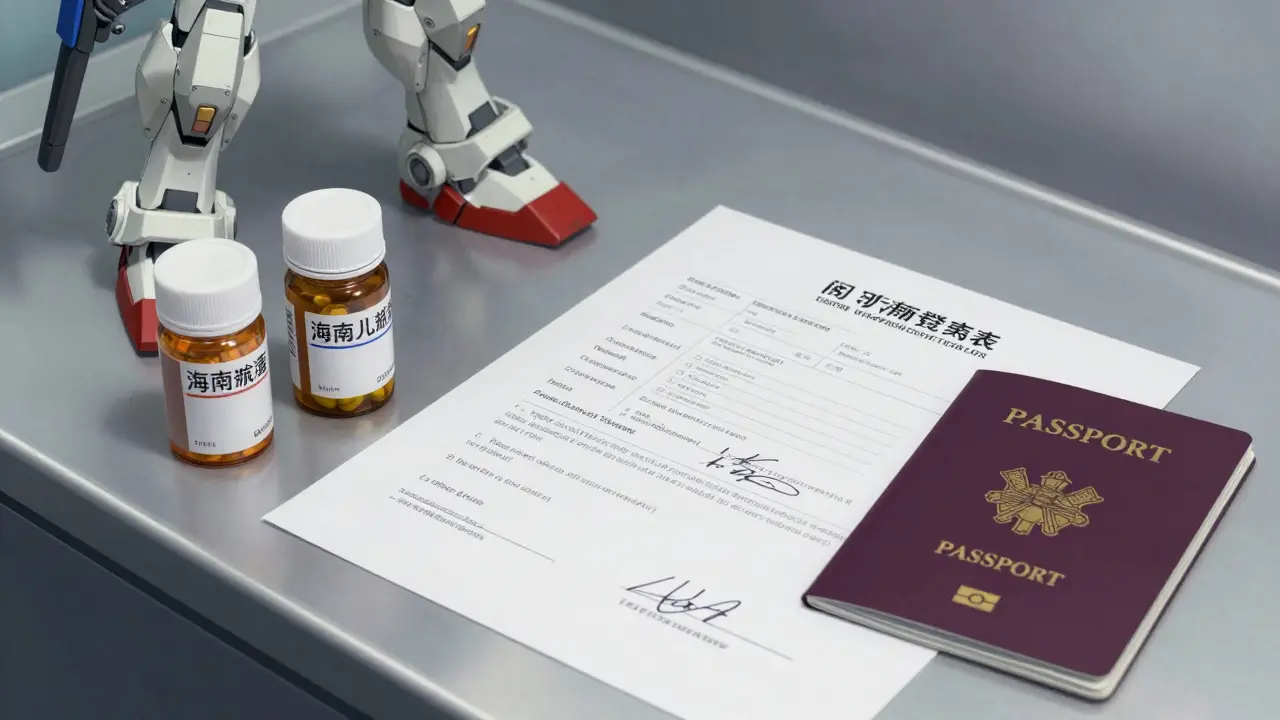
Japan is particularly strict. All Schedule I and II controlled substances, including Adderall (amphetamine/dextroamphetamine), are prohibited unless you obtain a Yakkan Shoumei is an import certificate issued by the Japanese Ministry of Health, Labour and Welfare. This process takes 7-10 business days and costs around $50. According to the U.S. Embassy Tokyo, 42% of American travelers to Japan experienced medication issues in 2023, mostly due to lack of this certificate.
The United Arab Emirates (UAE) bans several common medications entirely, including zolpidem (Ambien) and certain antidepressants. Even if you have a prescription, carrying these can result in severe penalties. Always check the UAE’s banned substance list before packing.
Australia requires prior approval through the Therapeutic Goods Administration (TGA) for all Schedule 8 controlled substances. You must apply online before departure. Arriving without this approval means your medication will be confiscated, and you may face fines.
Packing Smart: How to Carry Your Meds
Your documentation is only half the battle. How you pack your medication matters just as much. Border agents want to see transparency and consistency.
- Keep Original Containers: Never transfer pills to generic plastic bags or weekly organizers for international flights. 53% of medication issues at U.S. customs stem from repackaged medications. The original pharmacy label provides critical proof of purchase and prescription details.
- Carry-On Only: Always keep your medications in your carry-on luggage. Checked bags can get lost, delayed, or exposed to extreme temperatures that degrade the medicine. Plus, if your bag is inspected, you need immediate access to your documents.
- Limit Quantities: Bring only what you need for the trip plus a few extra days for delays. Carrying a six-month supply for a two-week vacation looks suspicious and suggests commercial distribution, which is illegal.
- Translate if Necessary: If your prescription is in a language other than English, consider getting a certified translation. While not always mandatory, it speeds up the inspection process significantly.
User experiences highlight the importance of these steps. On TripAdvisor, a traveler reported being detained for 47 minutes at JFK Airport because they had their prescription but no doctor’s letter. They had to call their physician to fax a letter explaining their chronic pain condition. Had they prepared this in advance, they would have walked through in seconds.
Timelines and Preparation Checklist
Don’t wait until the night before your flight. Start the documentation process 4-6 weeks before departure. Here is a realistic timeline:
- Week 6: Contact your prescribing physician to request a travel letter. Provide them with your itinerary and a list of medications.
- Week 5: Research your destination country’s specific medication laws. Check embassy websites for banned substances and special permits.
- Week 4: Apply for any required government certificates (like Japan’s Yakkan Shoumei or Australia’s TGA approval). These processes can take up to two weeks.
- Week 2: Pick up your medications from the pharmacy in their original containers. Ensure the labels are clear and legible.
- Week 1: Assemble your travel kit: doctor’s letter, copies of prescriptions, passport, and original medication bottles. Keep digital copies on your phone as backup.
Dr. Samuel Wong from Johns Hopkins University found that travelers who obtained country-specific authorizations before departure reduced border complications by 94%. The effort pays off in peace of mind.
What Happens If You Get Stopped?
If an officer questions your medication, stay calm and cooperative. Do not argue. Hand over your travel letter and original containers immediately. Explain clearly that the medication is for personal medical use and prescribed by your doctor. If you don’t speak the local language, ask for assistance or use a translation app. Remember, your goal is to provide evidence, not debate policy.
In rare cases where documentation is missing, some officers may allow you to contact your doctor remotely. However, this is not guaranteed and can cause significant delays. Prevention is always better than reaction.
Do I need a travel letter for non-controlled medications?
While not always legally required for non-controlled medications like antibiotics or blood pressure pills, it is highly recommended. A doctor’s letter clarifies the medical necessity and prevents misunderstandings, especially if the medication contains ingredients restricted in your destination country.
Can I mail my medications instead of carrying them?
Mailing controlled substances across borders is extremely risky and often illegal. Most countries prohibit mailing narcotics or psychotropic drugs. It is safer to carry them in your person with proper documentation. If you must ship, consult international shipping regulations and customs laws first.
How long does a doctor’s travel letter remain valid?
There is no universal expiration date, but most experts recommend getting a new letter for every trip or at least once a year. Ensure the letter reflects your current dosage and recent medical history to avoid suspicion.
What if my medication is banned in the country I’m visiting?
If a medication is completely banned, you cannot bring it, even with a prescription. Consult your doctor well in advance to find a legal alternative that is permitted in your destination country. Switching medications early ensures continuity of care without legal risks.
Is a digital copy of my prescription acceptable?
Digital copies are useful backups, but physical copies are preferred. Border officials may not accept screenshots or emails as primary proof. Always carry printed copies of your prescription and doctor’s letter in your carry-on bag.