 Mar, 14 2026
When your kidneys start to fail silently, you might not feel it-until it’s too late. IgA Nephropathy, or IgAN, is one of those quiet killers. It doesn’t come with a warning siren. No sharp pain. No fever. Just a bit of blood in the urine after a cold, or a routine lab test that shows protein leaking into your pee. For millions worldwide, this is the first sign of a disease that can lead to kidney failure. And in 2026, the way we treat it has changed-dramatically.
What Exactly Is IgA Nephropathy?
IgA Nephropathy is an autoimmune condition where your body makes too much of a faulty antibody called immunoglobulin A (IgA). Instead of fighting infections, this IgA clumps together, sticks to the filtering units of your kidneys (glomeruli), and triggers inflammation. Over time, that inflammation scars the filters. Once scarred, they can’t clean your blood anymore. The result? Protein and blood leak into your urine, and waste builds up in your blood.
First described in 1968 by French doctor Jean Berger, it’s now the most common cause of primary glomerulonephritis globally. In Asia, up to half of all kidney biopsies show IgAN. In the U.S. and Europe, it’s still the top cause in 25-40% of cases. It hits hardest in people between 15 and 35 years old. But here’s the catch: many don’t know they have it until their kidney function drops by 30% or more.
Prognosis: How Bad Can It Get?
The truth? IgAN doesn’t follow a straight line. Some people live decades with mild proteinuria and never need dialysis. Others lose kidney function within 10 years.
Current data shows that 30-50% of patients with persistent proteinuria will reach end-stage kidney disease (ESKD) within 10 to 20 years. That’s not a guess-it’s from large registry studies tracked over decades. But here’s what’s changed: we now know that proteinuria levels are the strongest predictor. A 2025 review from the Cleveland Clinic found that even patients with proteinuria between 0.44 and 0.88 g/g (of creatinine) still had a 30% chance of kidney failure in 10 years. That’s why the new guidelines don’t just say “get proteinuria under 1 gram”-they demand less than 0.5 grams per day.
That’s a huge shift. For years, doctors thought keeping proteinuria under 1 gram was good enough. Now, we know that’s not enough. Think of it like blood pressure: if you’re told to keep it under 140, but your doctor later says 120 is safer, you don’t stop at 130-you aim lower. Same logic applies here.
But proteinuria isn’t the only factor. The Oxford Classification (MEST-C score) looks at kidney biopsy findings: mesangial hypercellularity, endocapillary proliferation, segmental scarring, tubular atrophy, and interstitial fibrosis. Combine that with your blood pressure, eGFR, and how much protein you’re losing daily, and you get a risk score. High-risk patients? They need aggressive treatment-now.
The New Treatment Paradigm: Simultaneous, Not Sequential
For decades, the standard was this: start with blood pressure meds (RAS inhibitors like lisinopril or losartan). Wait three months. If proteinuria doesn’t drop enough, then add steroids or other immunosuppressants. That’s what the 2021 guidelines said.
But here’s the problem: while you’re waiting, your kidneys keep getting damaged. A 2025 Reddit thread from a user named GFR_Warrior captured it perfectly: “The 90-day wait felt like watching my kidney function decline unnecessarily.”
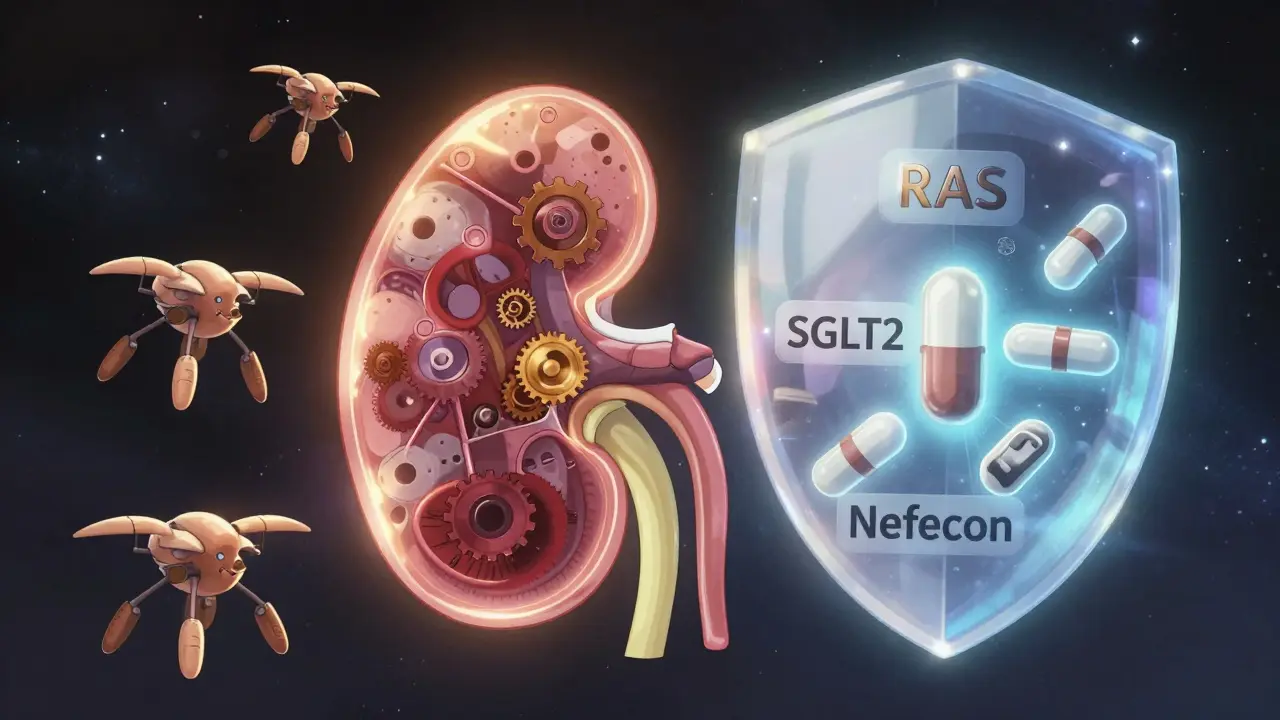
The KDIGO 2025 guidelines scrapped that. Now, if you’re at high risk-persistent proteinuria above 0.75 g/day with other risk factors-you start all your therapies at once:
- RAS inhibitors (ACEi or ARBs) to reduce pressure in the glomeruli
- SGLT2 inhibitors (like dapagliflozin) to cut proteinuria and protect kidney cells
- DEARA (sparsentan) to block endothelin, a molecule that worsens scarring
- Nefecon (targeted budesonide) to stop IgA production in the gut
- Systemic glucocorticoids (like prednisone) if Nefecon isn’t available or isn’t enough
This isn’t just a tweak. It’s a revolution. You’re no longer treating symptoms one at a time-you’re attacking the disease from multiple angles from day one.

Therapies That Actually Work (And Where They’re Used)
Not all treatments work the same everywhere. Geography matters.
Nefecon (brand name: Tarpeyo) is the first drug approved specifically for IgAN. The FDA greenlit it in December 2023. It’s a capsule that releases budesonide (a steroid) directly in the ileum-the part of the gut where faulty IgA is made. It cuts IgA production by 50-70% in trials. Side effects? Mostly mild: sore throat, headache. A 2025 survey of 150 IgAN patients found 72% preferred it over traditional steroids because of fewer side effects. But it costs $125,000 a year in the U.S. Insurance denials are common. One user on Facebook said, “I had to appeal four times before they covered it.”
Sparsentan (brand name: Filsuvez) is a dual endothelin receptor antagonist. Approved by the EMA in June 2024, it reduces proteinuria by 30-40% in 12 months. It’s especially useful if you can’t tolerate steroids.
Systemic steroids (like prednisone) still work-but they come with a cost. Weight gain, diabetes, bone loss, mood swings. Many patients, especially teens and those with obesity or diabetes, can’t handle them. That’s why Nefecon is such a game-changer.
Mycophenolate mofetil (CellCept) is common in China, where trials show it slows progression. But in Western trials, results were mixed. It’s not recommended by KDIGO unless you’re in a region with strong local evidence.
Tonsillectomy is routine in Japan-45% of eligible patients get it. The theory? Tonsils make excess IgA. Remove them, reduce IgA. Studies there show benefit. But in the U.S. or U.K., there’s no strong evidence. So it’s not recommended.
Hydroxychloroquine (Plaquenil) is used in China for its anti-inflammatory effects. Again-no global recommendation. But if you’re in a region where it’s standard, it’s worth discussing.
What’s Missing? The Big Gaps
Even with all these advances, we’re still flying blind in key areas.
First: we don’t have reliable biomarkers to tell who will respond to which drug. Should you take Nefecon? Sparsentan? Steroids? We guess. We use risk scores. But we don’t have a blood test that says, “This patient will benefit from APRIL blockade.” That’s coming-trials like TARGET-IgAN (NCT05921545) are hunting for those markers. Results by 2027.
Second: cost. $125,000 a year for Nefecon? That’s not sustainable. In low- and middle-income countries, only 22% of patients get guideline-recommended care. In high-income nations, it’s 85%. This isn’t just a medical issue-it’s an equity crisis.
Third: we don’t know if pushing proteinuria below 0.5 g/day is safe long-term. No trial has tested it. We’re extrapolating from data. That’s why experts like Dr. Fernando Fervenza say: “We don’t yet know the risk or benefit of trying to achieve that target.”

What Patients Are Really Saying
Online, patients are honest. On r/kidneydisease, one user wrote: “I’m on four meds. Two pills in the morning, two at night. My 16-year-old is overwhelmed.” That’s real. Treatment burden is real. The IgA Nephropathy Foundation’s 2024 survey of 1,200 patients found 83% said preserving quality of life was their top priority-not just kidney numbers.
That’s why the KDIGO 2025 guidelines say: “Treatment must be individualized.” Age. Comorbidities. Access. Tolerance. Culture. You can’t treat everyone the same. A 70-year-old with diabetes might not tolerate steroids. A teenager might refuse daily pills. A patient in a rural area might not be able to afford Nefecon. The goal isn’t just to stop kidney failure. It’s to let people live well while doing it.
What’s Next? The Road Ahead
The IgAN therapy market is exploding. From $150 million in 2024 to $2.1 billion by 2030, according to GlobalData. New drugs are in phase 3 trials: Ulotaront (Vera Therapeutics), APOL1 inhibitors, and complement blockers. The next decade will be about personalization: biomarkers, gene profiles, gut microbiome tests.
But until then, here’s what you need to do:
- Get your proteinuria measured regularly-ideally with a urine albumin-to-creatinine ratio (UACR)
- Know your eGFR and blood pressure numbers
- Ask if your kidney biopsy was scored using the MEST-C system
- Discuss whether you’re high-risk-and if so, whether you’re a candidate for Nefecon, sparsentan, or combination therapy
- Push for access. If insurance denies Nefecon, appeal. Document everything. Patient advocacy groups can help
The future of IgAN isn’t just about better drugs. It’s about smarter, earlier, and fairer care. The tools are here. The question is: who gets them?
Can IgA Nephropathy be cured?
No, IgA Nephropathy cannot be cured yet. But it can be controlled. With early, aggressive treatment using the KDIGO 2025 guidelines, many patients can slow or even stop progression to kidney failure. The goal isn’t a cure-it’s lifelong kidney protection.
What’s the difference between Nefecon and prednisone?
Nefecon targets IgA production right at its source-the gut-using a slow-release steroid that acts locally. It avoids high doses in the bloodstream, which means fewer side effects like weight gain, diabetes, or bone loss. Prednisone is a systemic steroid: it floods your whole body, suppressing immune activity everywhere. That’s why it causes more side effects. Nefecon is more targeted. Prednisone is broader and riskier.
Why is proteinuria below 0.5 g/day the new target?
Older studies thought keeping proteinuria under 1 gram was enough. But newer data from kidney registries showed that even patients with proteinuria between 0.44 and 0.88 g/g still had a 30% chance of kidney failure in 10 years. That’s why KDIGO 2025 lowered the target to under 0.5 g/day. Lower proteinuria = less kidney damage over time.
Is IgA Nephropathy hereditary?
It’s not directly inherited like cystic fibrosis, but genetics play a role. People with certain immune system genes (like HLA-DQ/DR variants) are more likely to develop IgAN. Family clusters exist, especially in East Asia. If a close relative has IgAN, you should get screened for proteinuria and blood in urine.
Can I still drink alcohol or smoke with IgA Nephropathy?
Smoking accelerates kidney damage and raises blood pressure-both bad for IgAN. Quitting is strongly advised. Alcohol isn’t banned, but it can raise blood pressure and interact with medications like steroids or SGLT2 inhibitors. Limit it. Most experts recommend no more than one drink per day, if any.
How often should I get my kidneys checked?
When you start treatment, check every month for the first 3 months: proteinuria, blood pressure, eGFR, and side effects. After that, every 3 months. If you’re stable and on long-term therapy, every 6 months is acceptable. Never go longer than 6 months without a check-up.