 Jun, 20 2026
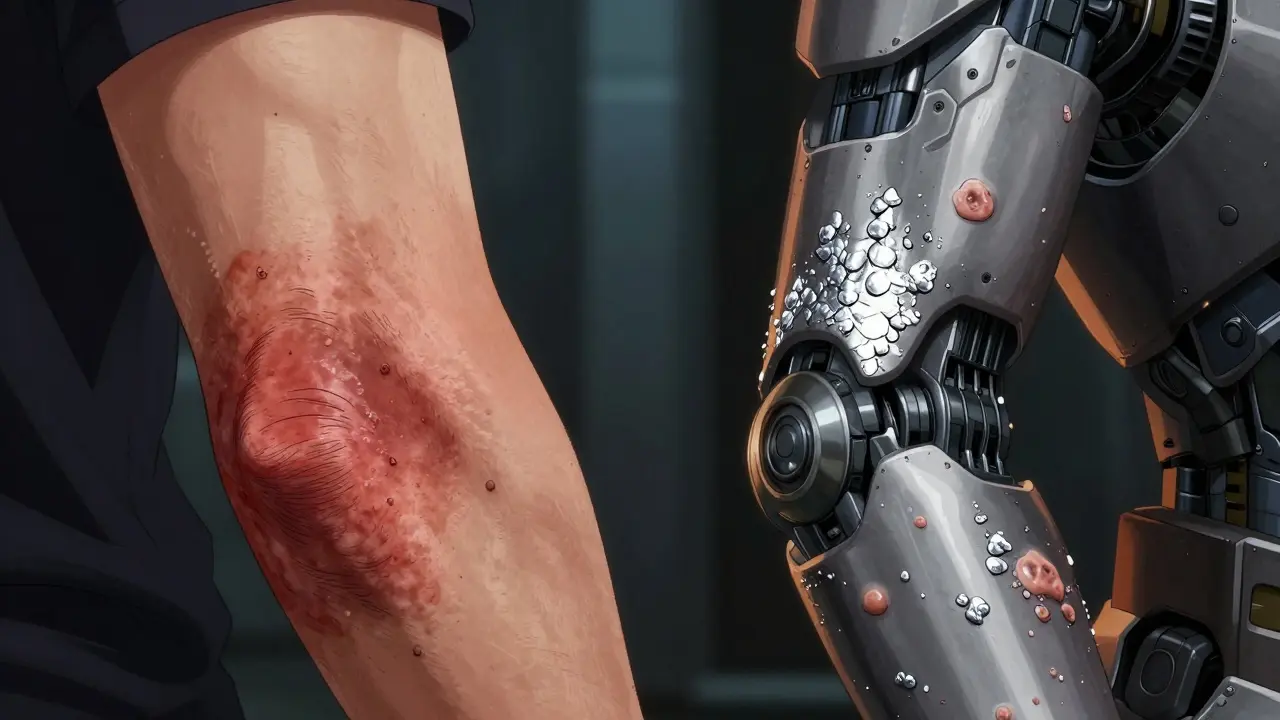
Have you ever looked in the mirror, spotted a patch of irritated skin, and immediately panicked? You’re not alone. Millions of people scratch their heads (literally) trying to figure out if they are dealing with eczema, also known as atopic dermatitis, or psoriasis. Both conditions cause redness, itching, and scaling, which makes them look deceptively similar at first glance. But here is the catch: treating eczema like psoriasis-or vice versa-can make things worse. Misdiagnosis happens in about 15-20% of cases, according to a 2022 study in the *Journal of the American Academy of Dermatology*. Getting it right matters because these two chronic inflammatory skin conditions have different roots, different triggers, and very different visual signatures.
The Location Game: Inside vs. Outside the Creases
If you want a quick way to narrow down what you are looking at, start with where the rash lives on your body. Dermatologists often say that location is the first major clue. Think of your joints. Eczema loves the "inside" of your bends-the flexural surfaces. If you see irritation in the crook of your inner elbows, behind your knees, or on your wrists and ankles, you are likely looking at eczema. In fact, clinical reviews show that over 90% of eczema cases involve these inner folds. Babies often get it on their cheeks too.
Psoriasis, on the other hand, prefers the "outside" of your bends-the extensor surfaces. Look at the outer part of your elbows, the front of your knees, your lower back, or your scalp. These are classic psoriasis hangouts. A massive study published in *JAMA Dermatology* found that nearly 89% of psoriasis cases affected these outer surfaces, while less than 10% of eczema cases did. So, if your rash is on the outside of your elbow, lean toward psoriasis. If it’s tucked inside the crease, lean toward eczema.
| Body Part | Eczema Likelihood | Psoriasis Likelihood |
|---|---|---|
| Inner Elbows (Flexural) | High (92%) | Low |
| Outer Elbows (Extensor) | Low | High (85%) |
| Behind Knees | High (89%) | Low |
| Front of Knees | Low | High (78%) |
| Scalp | Moderate | Very High (80%) |
| Face/Cheeks (Infants) | High (76%) | Low |
Visual Texture: Weeping vs. Scaling
Now, let’s talk about what the rash actually looks like up close. This is where the differences become stark. Eczema tends to look messy. The borders are usually poorly defined, meaning the rash blends into the surrounding healthy skin rather than having a sharp edge. The texture can vary wildly depending on the stage. In acute phases, eczema might look raw, weep fluid, or form yellowish crusts from scratching. Over time, chronic scratching leads to lichenification, where the skin becomes thickened and leathery, but it rarely forms heavy, flaky scales.
Psoriasis plaques are much more structured. They are raised, well-demarcated patches with clear, sharp borders. The hallmark of plaque psoriasis-which accounts for 80-90% of cases-is the thick, silvery-white scale that sits on top of the red base. If you gently scrape this scale, it often comes off in layers. In fact, a 2023 study in the *British Journal of Dermatology* noted that psoriasis scales are significantly thicker (averaging 0.5mm) compared to the fine, almost invisible scaling seen in eczema (0.1mm). Patients often describe psoriasis patches as looking like "armor plating," while eczema patients describe their skin as "raw" or "weepy."
The Auspitz Sign and Nail Clues
There is an old-school diagnostic trick called the Auspitz sign. If you pick at a psoriasis plaque and remove the silvery scale, you might see tiny pinpoint spots of bleeding underneath. This happens because psoriasis speeds up skin cell production so much that blood vessels near the surface get stretched thin and rupture easily. Eczema does not do this. If you scratch eczema, it might bleed from the open sore, but you won’t see those distinct pinpoint dots emerging from intact-looking skin beneath a scale.
Your nails can also give away the game. Psoriasis frequently attacks nails, causing pitting (small dents in the nail plate) in about half of patients. It can also cause onycholysis, where the nail lifts away from the bed, often turning yellow or brown. Eczema rarely affects nails in this way. While severe eczema might cause some ridging or discoloration, true pitting and lifting are strong indicators of psoriasis. If your fingernails look hammered-out or separated, check your elbows and knees for psoriasis plaques.
Skin of Color: Why Textbooks Can Be Misleading
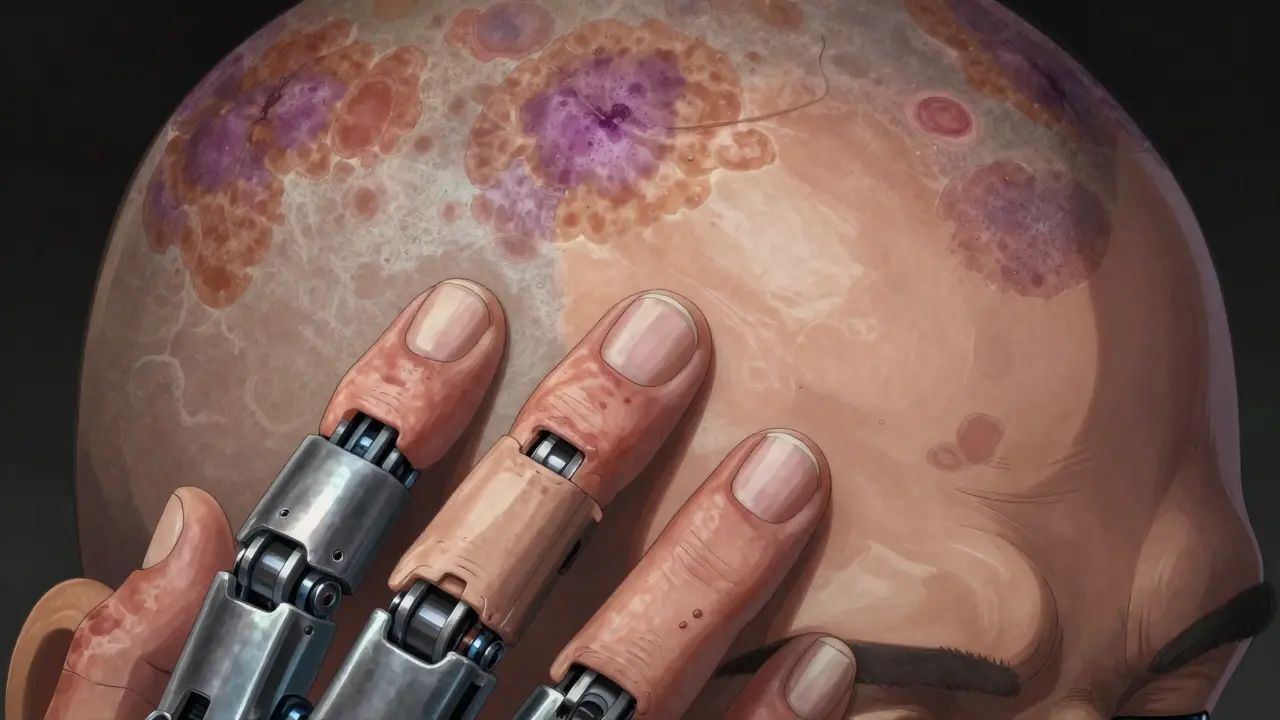
If you have darker skin tones (Fitzpatrick types IV-VI), the classic "red and white" description of these rashes doesn’t always apply. This is a huge gap in medical education, leading to higher misdiagnosis rates-up to 35% higher-for people of color. On medium to dark skin, eczema often appears as ashen, purple, gray, or hyperpigmented (darker) patches rather than bright red. The inflammation is still there, but melanin masks the redness. It might look more like dry, rough patches with subtle scaling.
Psoriasis on darker skin also changes its costume. Instead of bright red plaques with white scales, it often presents as violet, dark brown, or violaceous patches. The silvery scale might be finer and harder to see against dark skin. However, a key clue remains: the border is still well-defined. Recent research from UCSF’s Skin of Color Program highlights that psoriasis lesions on darker skin often have a "halo" of hypopigmentation (lighter skin) around the active lesion, which is absent in eczema. Recognizing these variations is crucial, as delays in diagnosis for patients of color can average over 14 months compared to just five months for lighter-skinned patients.
Triggers and Behavior: Flare-ups vs. Stability
How the rash behaves over time can also help you distinguish between the two. Eczema is highly reactive to external triggers. Did you switch laundry detergent? Are you stressed? Is the air dry? Eczema flares up quickly in response to irritants, allergens, and environmental changes. It tends to fluctuate-getting better and worse in waves. The itching is often intense and relentless, described as a "fire ant bite" sensation.
Psoriasis is driven more by internal immune system issues, though stress and infections (like strep throat) can trigger it. Once a psoriasis plaque forms, it tends to stay put unless treated. It doesn’t usually come and go as rapidly as eczema. Another unique feature of psoriasis is the Koebner phenomenon. If you cut, scratch, or injure your skin, new psoriasis plaques may develop exactly along the line of injury. This happens in 25-30% of psoriasis patients but is rare in eczema. So, if you notice new patches appearing after a paper cut or a scrape, think psoriasis.
When to See a Dermatologist
While these visual clues are helpful, self-diagnosis has limits. Teledermatology AI tools have reached about 85% accuracy in distinguishing these conditions, but even experts recommend an in-person exam, especially for complex cases or skin of color presentations. If your rash is spreading, painful, showing signs of infection (pus, warmth, fever), or not responding to over-the-counter hydrocortisone or moisturizers, book an appointment. A dermatologist can use dermoscopy-a magnifying tool-to look at blood vessel patterns. Psoriasis typically shows dotted vessels, while eczema shows polymorphous (mixed) vessels. This level of detail confirms the diagnosis and ensures you get the right treatment plan, whether that’s topical steroids for eczema or biologics for severe psoriasis.
Can you have both eczema and psoriasis?
Yes, it is possible to have both conditions simultaneously, though it is relatively rare. This overlap can make diagnosis challenging because symptoms may blend. If you have features of both (e.g., flexural involvement with thick scaling), a dermatologist will need to evaluate you carefully, possibly using a skin biopsy to confirm the diagnosis.
Does psoriasis itch as much as eczema?
Both conditions can be extremely itchy, but eczema is generally considered more intensely pruritic (itchy). The itch in eczema is often described as unbearable and is a primary symptom. Psoriasis can itch, burn, or sting, but the discomfort varies more widely among patients. Some people with mild psoriasis experience little to no itching.
Is eczema contagious?
No, neither eczema nor psoriasis is contagious. You cannot catch either condition from touching someone who has it, sharing towels, or being in the same room. Both are chronic inflammatory conditions linked to genetics and immune system dysfunction, not bacteria or viruses.
What is the best moisturizer for eczema vs. psoriasis?
For eczema, fragrance-free creams or ointments that repair the skin barrier (containing ceramides) are essential. For psoriasis, thicker emollients containing salicylic acid or urea can help break down the thick scales. However, moisturizers alone rarely cure either condition; they are supportive treatments used alongside prescription medications.
Why do I keep getting misdiagnosed?
Misdiagnosis is common because early-stage psoriasis and eczema can look identical. Additionally, many general practitioners receive limited training in diagnosing skin conditions on diverse skin tones. If you feel your diagnosis is wrong, seek a second opinion from a board-certified dermatologist who specializes in your specific skin type.